
Podcast: Download (Duration: 43:35 — 50.2MB)
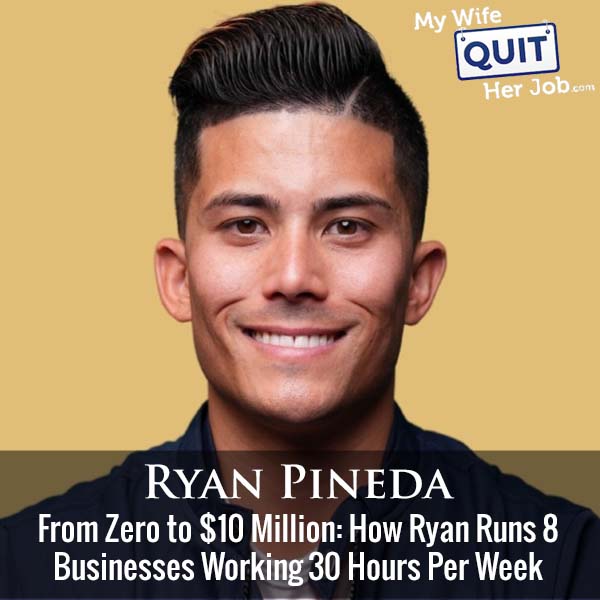
You run multiple businesses in 30 hours a week by refusing to be the operator in any of them, structuring them under a parent company with a shared C-suite, and only starting a new one when there is an existing operator ready to run it. That is exactly how Ryan Pineda runs 8 companies, 80-100 employees, and $10M+ in annual revenue while spending most of his time creating content and dreaming up the next play.
Ryan came on the show to walk through his portfolio (house flipping, a 200-agent real estate brokerage, a coaching program, an accounting firm called TrueBooks, a real estate fund, an NFT project, a media company and more) and the operating model that keeps it manageable. He is a former Oakland A’s draft pick who went from flipping couches for $8K/month to running a holding company called The Pineda Company.
Here is his framework, the “3 pillars” he thinks anyone building wealth needs to pick from, and the honest tradeoffs on risk, kids and management.
Get My Free Mini Course On How To Start A Successful Ecommerce Store
If you are interested in starting an ecommerce business, I put together a comprehensive package of resources that will help you launch your own online store from complete scratch. Be sure to grab it before you leave!
Table of Contents
Key takeaways
- Ryan runs 8 businesses in 30 hours a week by only starting a new company when a named operator is in place first. He is never the day-to-day manager.
- His holding company (The Pineda Company) has a shared C-suite (CEO, CFO, CTO, COO) that supports each portfolio company’s own C-suite. Ryan does not run meetings and does not manage individuals.
- He publishes 40-50 pieces of content a day off roughly 10 hours a week of filming. One podcast turns into clips, tweets, and blog posts across every platform.
- The 3 pillars of wealth: business, investments, and influence. Doing one well makes you wealthy. Combining them is where outsized outcomes come from.
- Every business Ryan started came from demand he already knew existed: his own students kept asking who his CPA was, so he launched TrueBooks with his CPA as operator.
- Risk framing when you are young and broke: “Zero is the same as negative $50,000.” If the downside is bankruptcy at 24, the upside asymmetry is huge. That math flips as you take on kids and dependents.
How does Ryan Pineda run 8 businesses in 30 hours a week?
Ryan Pineda runs 8 businesses in 30 hours a week by putting an operator in charge of every company before it starts, structuring everything under a parent holding company with a shared C-suite, and staying strictly in the visionary role. He does not run day-to-day meetings, does not manage individual employees, and only steps in for vision, marketing and capital.
The structure looks like this. His parent company, The Pineda Company, owns each sister business (Wealthy Investor, TrueBooks accounting, Pineda Media, and the rest). The parent-level C-suite (CEO, CFO, CTO, COO) supports each sister company’s own C-suite.
When it is time to hire or fire in a sister company, that is the COO of the sister company talking to the COO of the parent. Ryan says he walks into the office and meets new employees for the first time.
His own rule: “I won’t start a business at this point unless we have an operator in place.” That single filter is what makes 8 companies fit in 30 hours a week.
The visionary vs integrator split (why Ryan does not manage anyone)
The visionary vs integrator split is the operating pattern Ryan uses to stay out of management: he is the visionary who creates ideas, marketing pull and vision, and his COO and each sister-company operator is the integrator who runs the meetings and manages the people. He credits the model to EOS (Entrepreneurial Operating System) and is emphatic about staying on the visionary side.
Why he refuses to manage people: managing is the job he hated as a realtor. He describes himself as “a visionary through and through,” meaning he adds value by envisioning where the company can go, not by sitting in operations reviews. His view is that the company can only grow as big as he envisions it, and there are always integrators he can hire to run the day-to-day.
The practical result: he does not sit in meetings, does not run one-on-ones, and does not personally hire or fire. Those calls happen at the operator level.
The 3 pillars of wealth: business, investments, influence
Ryan’s 3 pillars of wealth are business, investments, and influence, and he says doing any one of them well will make you wealthy, but combining them is where outlier outcomes live. This is the framework he teaches inside Wealthy Way.
- Business is starting and scaling a company. Direct margin, direct control, hardest to start but highest ceiling.
- Investments is compounding capital by being good at deals. Real estate, stocks, private deals. Requires savvy more than skill labor.
- Influence is attention as currency. If you build a large audience, money and opportunities come to you.
Ryan’s own path stacked them in that order: he started as an investor (flipping houses), then became a business owner (brokerage, coaching, accounting, media), and only later became an influencer with a million-plus followers. He is clear that starting with influence is possible today in a way it was not 10 years ago, and it makes everything else easier because you have distribution.
How Ryan publishes 40-50 pieces of content a day off 10 hours of filming
Ryan publishes 40-50 pieces of content a day by filming long-form (mostly podcasts) for about 10 hours a week, then handing the raw footage to a team that cuts, captions, transforms and distributes it across every platform. He is the mouth. The team is the machine.
The distribution stack:
- Long-form podcasts are the source. He prefers them because they are informal and require no prep.
- Team cuts clips for YouTube Shorts, Instagram Reels and TikTok.
- Team turns spoken lines into tweets, threads and blog posts.
- Everything ships across every channel on the same day.
His view is that this is a machine like any other business: he provides the input, the team owns the output. It scales because he is not the one making the individual pieces.
Why every Ryan Pineda business started as demand from an existing audience
Every Ryan Pineda business started because customers of his existing business kept asking for the next service, and he answered by finding an operator and standing up the company. That is the demand-first sequencing that keeps him from starting things nobody wants.
The concrete chain from the episode:
- Flipping houses worked, so people asked how he did it. He wrote Flip Your Future (2018) and launched a coaching program.
- Coaching students kept asking “who is your CPA?” He went to his own CPA, made him the operator, and started TrueBooks.
- Buyers kept asking about deals, so he started a fund and began buying apartment buildings.
- Entrepreneurs kept asking how he ran content, so he started Pineda Media, a done-for-you social media production shop.
Ryan’s line: “When people keep telling you they want to give you money, you’re just like, all right, fine. Let me build this.”
The 3 things a partner buys when they bring Ryan into a business
When someone brings Ryan into a business as a partner, they are buying one of three things: marketing pull, systems and strategy, or capital. He was direct about which is which.
- Marketing. His organic reach and the ability to funnel from one Pineda business into another (a coaching student needs a CPA either way, so TrueBooks gets the flow).
- Strategy and systems. How to build funnels, websites, ads, sales teams and hiring pipelines at a high level. Turning a business into “a machine that does not need my face on it.”
- Capital. Direct investment when it makes sense. Pineda Partners is the newest arm and exists specifically to acquire and scale established businesses instead of starting from zero.
Ryan says he is actively trying to reduce the “marketing” side of the trade because he can only promote so many things, and he would rather buy or partner with already-built machines going forward.
The risk math when you are 24 and broke
Ryan does not think maxing out credit cards to flip a house at 24 was risky, because at 24 with no dependents the downside was bankruptcy and a two-year reset. His actual framing on the episode was that “zero is the same as negative $50,000” when you are young.
His scenario-by-scenario read at the time he bought his first flip:
- Best case: flip works, net $25K, buy another.
- Middle case (70-80% probability by his estimate): break even or small loss because he was a licensed realtor and understood values.
- Worst case (~20% probability): lose the house, end up $50K in debt, declare bankruptcy at 24, reset in 2 years.
The takeaway is not that new entrepreneurs should max their credit cards. Ryan’s argument is that the same debt he encourages young people to consider (a credit card, a business loan) is structurally identical to a mortgage or student debt.
Debt is a tool. What matters is what you use it for.
How the risk math changes when you have kids
The risk math changes completely once you have a spouse and kids, and Ryan was blunt that he would not take the same swings today with a family that he took at 24 with no dependents. As you get older, you make more money, you have more to lose, and each additional dollar is worth less to you than the first million was.
His practical advice for the 35-year-old stay-at-home mom listening to this show: side hustles have very little downside risk. You are not risking the family’s primary income; you are risking spare time.
Pick one of the 3 pillars (business, investments, influence), pick the one that matches your natural skills, and start.
For someone in a dead-end W-2 who wants out, his advice is not to quit tomorrow. It is to spend every available waking hour learning a new skill (real estate, content, an online business, freelancing) and forge a parallel path while the W-2 pays the bills.
What Ryan would start over with today if he were broke
If Ryan were starting over broke today, he would still choose real estate as an investor because it builds long-term wealth, requires no special credentials, and has entry paths that do not require your own capital. He was clear that he loved being a real estate investor even though he hated being a real estate agent. The difference was ownership vs client service.
His broader answer, though, was that the right first move depends on your natural skills:
- Good with people and deals? Start a business.
- Great with numbers? Investments (real estate, stocks).
- Charismatic on camera? Influence and content.
- Introverted and technical? Freelance back-end services for other operators.
And if he were broke with a family, he would do a hybrid: try to build the business AND document the journey publicly so the content compounds regardless of whether the business succeeds.
How Ryan structures a holding company with 80-100 employees
Ryan structures his holding company by putting a shared C-suite (CEO, CFO, CTO, COO) at the parent level and pairing them with a dedicated operator inside each sister company. That parent-level C-suite is the connective tissue that keeps 80-100 employees functional without any of them reporting to Ryan.
The reporting pattern in practice:
- Each sister company (Wealthy Investor, TrueBooks, Pineda Media, and the rest) has its own operator.
- That operator reports up to its counterpart at The Pineda Company (COO to COO, CFO to CFO).
- Parent-level executives handle their function across the whole portfolio, so a hiring push in one company gets the benefit of the parent’s HR playbook.
- Ryan sits above all of it as visionary. He does not attend the operating meetings.
This is why his line “I walk into the office and there’s new people there every week, I’ve never talked to them” is not a joke. It is the design.
Frequently asked questions
How many businesses does Ryan Pineda run?
Ryan Pineda runs 8 businesses through his parent holding company, The Pineda Company. They span real estate investing (Wealthy Investor), a coaching program, an accounting firm (TrueBooks), a real estate fund, an NFT project, a media company (Pineda Media), and a partnership vehicle (Pineda Partners), among others.
How many hours a week does Ryan Pineda work?
Ryan Pineda works about 30 hours a week across 8 businesses and 80-100 employees. He achieves that by staying in the visionary role, refusing to manage day-to-day operations, and requiring a named operator to be in place before he starts or acquires any new company.
What is the “3 pillars of wealth” framework?
The 3 pillars of wealth are business, investments, and influence. Ryan teaches that being great at any one of them will build meaningful wealth, and stacking them (for example, using influence to bring leads into a business or a fund) is how outlier outcomes get built.
How does Ryan Pineda produce 40-50 pieces of content a day?
Ryan Pineda films around 10 hours a week (mostly long-form podcasts) and hands the raw footage to his team, which cuts short-form clips for YouTube, Instagram and TikTok, transforms spoken lines into tweets and blog posts, and ships across every platform. The system is designed so his only input is being on camera.
What is TrueBooks?
TrueBooks is Ryan Pineda’s accounting firm, launched in partnership with his own CPA acting as the operator. It exists because his coaching students kept asking who he used for tax and accounting, and he productized the referral.
What does “visionary vs integrator” mean?
Visionary vs integrator is a role split popularized by EOS (Entrepreneurial Operating System), where the visionary generates ideas and direction and the integrator executes and manages the day-to-day. Ryan runs strictly as the visionary and hires integrators to run every one of his companies.
Should I max out my credit cards to start a business?
Whether you should take on personal debt to start a business depends on your life stage, dependents and risk tolerance, and Ryan’s own view is that debt is a tool that is only risky depending on what you use it for. He took on credit card debt and hard money loans at 24 with no dependents; he would not make the same call today with a family.