
Podcast: Download (Duration: 53:49 — 74.2MB)
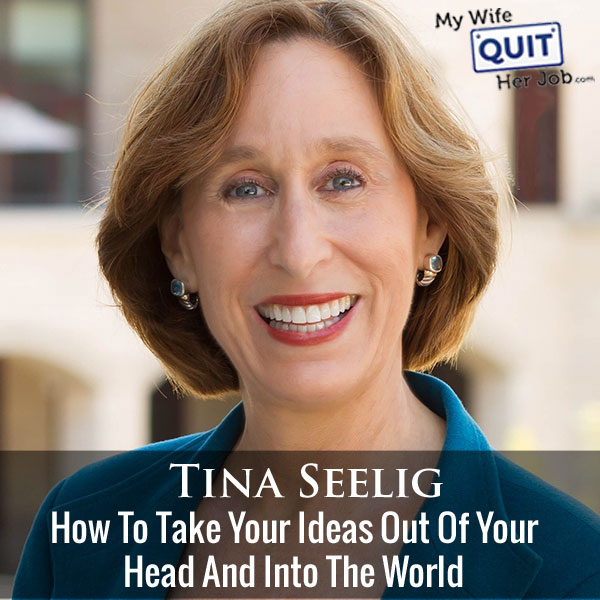
Creativity is a learnable skill rather than a fixed trait, and the fastest way to become more creative is to question the question you are asking. Tina Seelig teaches entrepreneurship at Stanford, and her point is that the answer is always baked into how you frame the problem.
Tina was my entrepreneurship professor at Stanford in 1999, and her class is what gave me the courage to start my own business. She is faculty director of the Stanford Technology Ventures Program and has written 17 books.
Her framing separates four terms most people use interchangeably. Imagination envisions what does not exist, creativity applies it to a problem, innovation produces something new to the world, and entrepreneurship scales it.
This episode covers why creative ideas are new to you while innovative ideas are new to the world, how to reframe a problem to open up better solutions, the passion and confidence matrix, and how to test an idea for almost nothing.
Get My Free Mini Course On How To Start A Successful Ecommerce Store
If you are interested in starting an ecommerce business, I put together a comprehensive package of resources that will help you launch your own online store from complete scratch. Be sure to grab it before you leave!
Table of Contents
Key takeaways
- Creativity is a learnable skill like math or music, and training reliably improves it.
- Creative ideas are new to you, and innovative ideas are new to the world.
- Reframe the question before solving it, since the answer is embedded in how you ask.
- Puzzle builders stop when a piece is missing, and quilt makers use whatever resources reach the goal.
- Attitude moves you up the passion axis and action moves you right along the confidence axis.
- Passion follows engagement rather than preceding it, so start doing things before you find your calling.
- Test ideas with pretotypes: a menu item you have not cooked, a wooden block standing in for a device.
- Opinions are worthless without skin in the game, so require an email address or a deposit.
Can you learn to be more creative?
Yes. Creativity is not like eye color, and nobody asks whether math or history or music can be taught.
Everyone starts creative. Watch any small child, and the problem is what happens afterward.
Schools are built to measure teaching outcomes, and creativity resists measurement. Because it is hard to count, it does not get taught.
Tina’s favorite line on this captures the trap. Not all things that count can be counted, and not all things that can be counted count.
Entrepreneurship follows the same logic. You may not become world class, and training reliably makes you better.
What is the difference between creativity and innovation?
Creative ideas are new to you, and innovative ideas are new to the world. Confusing the two makes people stop short of genuine innovation.
The full hierarchy runs in four steps. Imagination envisions what does not exist, creativity applies imagination to a problem, innovation produces a unique solution, and entrepreneurship scales that innovation.
Tina compares it to learning language. Babies babble, sounds become words, words become sentences, sentences become stories.
The cycle closes rather than ending. Scaling an idea requires inspiring other people’s imagination, which starts the same cycle for them.
Most problems do not need innovation. A creative solution handles about 99% of daily life, and reserving innovation for what truly requires it is the correct allocation.
How do you reframe a problem to get better ideas?
Change the words in your question and watch the solution space expand. The answer is baked into the question before you start.
Her example is a birthday. Planning the best birthday party assumes a party, and planning the best birthday celebration opens far more options.
Push further and it widens again. The best way to mark your birthday, the best birthday present, the best way to surprise you, the best birthday ritual.
The same works on serious problems. Curing cancer, preventing cancer, helping people live better with cancer, and supporting the families of people with cancer are four different projects.
Tina calls the practice frame storming. Brainstorm the questions before you brainstorm any solutions.
Unpacking assumptions is a reliable method. List everything you assume about restaurants or hotels or family vacations, then invert each one.
The instinct to rush past this comes from school. You are handed a question and rewarded for reaching the answer, so nobody practices interrogating the question itself.
What is the puzzle versus quilt mindset?
Puzzle builders assemble someone else’s picture and stop when a piece is missing. Quilt makers start from the goal and use whatever resources are available to reach it.
The workplace version is recognizable. A puzzle builder says the part is out of stock or the person who handles that is on vacation.
Falling in love with the problem is what separates them. The puzzle is a solution someone else designed, and the quilt is the problem you actually own.
Peter Diamandis illustrates the difference. Seeing a Murphy’s Law poster reading “if anything can go wrong, it will,” he crossed out the ending and wrote “fix it.”
How do you find work you are passionate about?
Stop searching for your passion and start engaging with the world, because passion follows engagement rather than preceding it. Asking what your passion is turns out to be the wrong question.
Scott Harrison is Tina’s example. In his twenties he was a nightclub promoter and self-described loser whose job was getting people drunk.
He wrote to charitable organizations and was rejected repeatedly. Mercy Ships eventually accepted him, and he went to Liberia without knowing where it was.
Waterborne disease there became the thing he could not ignore. He returned to New York, applied his promotional skills, and founded Charity Water.
Nothing about that was predestined. He knew nothing about Liberia, its water problems, or those diseases before he showed up.
You do not need a lightning strike. A small motivation leads to an experiment, which produces more motivation and another experiment.
How do you use the passion and confidence matrix?
Map your activities on two axes, passion vertical and confidence horizontal, then recognize that attitude moves you up and action moves you right. Both are things you control.
The upper left is the interesting quadrant. High passion and low confidence covers skiing, singing, cooking, the things people dream about rather than do.
Doing the thing is what moves it right. Confidence comes from engagement, and no amount of declaring passion substitutes.
The lower left is where outsourcing belongs. Low passion and low confidence tasks are candidates to trade away or hire out.
The lower right is where most work sits. High confidence and low passion describes spreadsheets and reports, and the question worth asking is what drained the passion.
Not everything belongs in the upper right. The point is deciding deliberately where to put your energy.
Start from interests rather than skills. Passion is a stronger driver than competence, so building confidence in something you already care about beats manufacturing enthusiasm for something you are merely good at.
How do you test a business idea cheaply?
Build a pretotype, a tiny experiment that tests demand before you build anything. Alberto Savoia coined the term after a company that sold for $100 million and one that lost $30 million.
His conclusion was about direction rather than execution. You can build it right and still build the wrong it.
The restaurant version is trivially simple. Put dishes you have never cooked on the menu, see what people order, and apologize that you have run out.
Jeff Hawkins tested the Palm Pilot with a block of wood. He cut it to the form factor, wrapped it in paper with an imagined interface, and carried it for weeks to see how he would use it.
The Apple Newton had already failed, which made the question real. He needed to know whether anyone wanted the thing before building it.
Real validation needs more people than one founder. Tina notes that a proper pretotype puts the object in other people’s hands.
Cheap channels are everywhere. A few ads, flyers around a campus, or a signup page tests a workshop before you schedule it.
Why opinions do not validate a business idea
Ask whether people will buy, because agreement costs nothing. Anyone will tell you an idea sounds good.
Skin in the game is the only real signal. An email address is a minimum, and money is better.
Tesla is the extreme version. Buyers put down thousands of dollars before the car existed, which is what justified building it.
Falling in love with your solution is the failure mode. Spending months and real money before discovering nobody wants it is avoidable.
What does it take to turn an idea into a company?
Persistence and the ability to inspire other people. Each stage of the cycle pairs an attitude with an action, and these are the hardest.
The earlier pairs are gentler. Imagination needs engagement and envisioning, creativity needs motivation and experimentation, innovation needs focus and reframing.
Persistence covers what business schools teach. Strategy, finance, marketing, organizational behavior, leadership.
Inspiring others is the part people underrate. Storytelling attracts team members, investors, customers, and reviewers.
Building something is never solo. Tina calls it a barn raising, requiring other people as motivated as you are.
Grit gets harder as you progress. The focus and persistence demanded at the innovation and entrepreneurship stages are what separate people who succeed.
Teams sustain you through the bad stretches. Building people around you who hold each other up is among the most effective things you can do.
How do you tell a story that sells your product?
Use the story spine, which moves from situation to intervention to consequences. Once upon a time, and every day, until one day, because of that, until finally, and ever since then.
The opening establishes the problem concretely. Hundreds of millions of people struggle with tremors, and every day feeding themselves and buttoning a shirt is a battle.
“Until one day” is where your product enters. Everything after that paints the consequences.
The best product fails without this. If the story does not place the listener inside it and show them a transformed life, it does not sell.
Non-utility products work identically. Clothing and jewelry are sold aspirationally, on a vision of who you become wearing them.
How do you know when to give up on an idea?
Decide in advance how much you are willing to invest, then hold yourself to it. Research on why founders sell their companies found the trigger was almost always a personal life event rather than a business one.
Burnout, a new child, or a strained marriage is what actually ends things. The decision comes from outside the business.
People differ enormously in what they will commit. Asked how long they would work on curing cancer, some say a lifetime and others say four years.
Bounding the effort up front is the practical move. My wife and I gave ourselves two years to make our store work, which is a different commitment from a lifetime.
Match the project to what you can genuinely give. Someone training for a race or working around young children has a real constraint, and honesty about it beats pretending otherwise.
Frequently asked questions
Can creativity be taught?
Yes. Creativity is a skill like mathematics or music, improvable with training. Everyone starts creative, and schooling tends to suppress it because creativity resists measurement.
What is the difference between creativity and innovation?
Creative ideas are new to you, while innovative ideas are new to the world. Most everyday problems only require creativity.
How do you come up with more innovative ideas?
Question the question. Changing “best birthday party” to “best way to mark your birthday” dramatically widens the solutions available, because the answer is embedded in the framing.
How do you find your passion?
Engage with the world first. Passion follows involvement rather than preceding it, so small motivations and experiments compound into genuine interest.
What is a pretotype?
A tiny, cheap test of whether people want something before you build it, such as listing a dish you cannot cook or carrying a wooden block shaped like a device.
How do you validate a business idea?
Require skin in the game. Opinions cost nothing, so ask for an email address or a deposit rather than asking whether someone would buy.
What makes a good business story?
The story spine: once upon a time, and every day, until one day, because of that, until finally, and ever since then. It places the listener in the problem before your solution appears.
When should you give up on a business idea?
Decide your limit in advance. Founders usually sell because of a personal life event rather than business performance, so defining what you will invest protects you from drifting.