
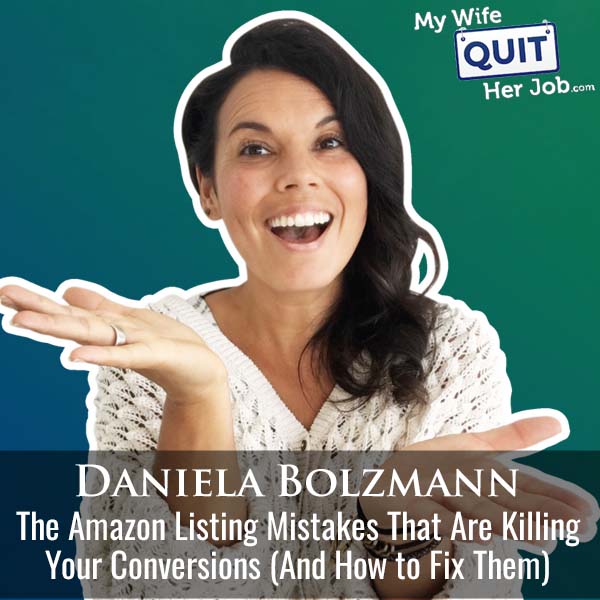
628: The Amazon Listing Mistakes That Are Killing Your Conversions (And How to Fix Them) With Daniela Bolzmann

628: The Amazon Listing Mistakes That Are Killing Your Conversions (And How to Fix Them) With Daniela Bolzmann

In this episode, I sit down with Daniela Boltzmann, founder of Mindful Goods, to talk about what actually separates high-converting Amazon listings from the ones that quietly bleed sales.

We dig into why repurposing your Shopify creative on Amazon is one of the most common and costly mistakes sellers make, and walk through the exact frameworks Daniela uses to optimize main images, titles, and A+ content for seven and eight-figure brands.

Get My Free Mini Course On How To Start A Successful Ecommerce Store

If you are interested in starting an ecommerce business, I put together a comprehensive package of resources that will help you launch your own online store from complete scratch. Be sure to grab it before you leave!

What You’ll Learn

  • Why repurposing your Shopify creative on Amazon is silently killing your conversions
  • How to optimize your main images, titles, and A+ content the way seven and eight-figure brands do it
  • What actually separates a high-converting Amazon listing from one that quietly bleeds sales

Sponsors

SellersSummit.com – The Sellers Summit is the ecommerce conference that I’ve run for the past 9 years. It’s small and intimate and you’ll learn a ton! Click Here To Grab A Ticket.

The Family First Entrepreneur – Purchase my Wall Street Journal Bestselling book and receive $690 in free bonuses! Click here to redeem the bonuses

Transcript

00:00
Welcome back to the podcast, the show where I cover all the latest strategies and current events related to e-commerce and online business. In this episode, I sit down with Daniela Boltzman, founder of Mindful Goods, to talk about what actually separates high converting Amazon listings from the ones that quietly bleed sales. We dig into why repurposing your Shopify creative on Amazon is one of the most common and costly mistakes that sellers make and walk through the exact frameworks Daniela uses to optimize main images, titles, and A-plus content for seven and eight figure brands.

00:29
But before we begin, want to let you know that tickets for Seller Summit 2026 are now on sale over at sellersummit.com. And if you sell physical products online, this is the event that you should be at. Unlike most events that are filled with high level fluff and inspirational stories, Seller Summit is all about tactical step-by-step strategies you can actually use in your business right away. Every speaker I invite is in the trenches, people who are running their own e-commerce stores, managing inventory, dealing with suppliers, and scaling real businesses. No corporate execs and no consultants.

00:58
Also, I hate large events, so I intentionally keep it small and intimate. We cap attendance at around 200 people, so you can actually have real conversations and connect with everyone in the room. We’ve sold out every single year for the past nine years, and I expect this year to be no different. It’s happening April 21st to 23rd in Fort Lauderdale, Florida, and if you’re doing over 250K or $1 million in revenue, we also offer a private mastermind for high-level sellers. Right now, tickets are the cheapest they’re ever gonna be.

01:27
So if you want in, go over to sellersummit.com and grab your ticket. Now on to the show.

01:38
Welcome to the My Wife Quarter job podcast. Today I’m excited to have Daniela Boltzman on the show. Now, Daniela was introduced to me by a good friend, Ritu Java, and Daniela is the founder of mindfulgoods.co where she helps Amazon sellers with Amazon listing optimization and branding. And her female led agency has had their work featured in many case studies by Amazon and they provide a done for you service that makes your products stand out and sell.

02:07
She’s also spoken at many events, including Amazon Accelerate. And as we all know, Amazon is getting more more competitive every year. So today I invited Daniela to come on the show to talk about how to make your Amazon listing stand out in a sea of competition. And with that, welcome to the show. Oh, thank you for having me. My favorite topic. I’m excited to be here. I thought we were going to talk about tennis, actually, but.

02:35
Second favorite topic. Actually, I’ve been getting into paddle now. Do you play paddle? No, what is that? It’s Padel. Some people say Padel. It’s of like, what is it that they play in the States? Pickleball. it’s with glass. It’s like pickleball, but with glass walls behind you. So it’s like, yeah, it’s really, really fun. It started in Mexico, spread to Europe. It’s more popular than pickleball in Europe.

03:03
And it’s a lot of fun. And I love tennis. I play tennis like three times a week, but I’m really into paddle as well. Okay, I can’t get into pickleball as much because it’s not as much of a workout for me, which is why I like tennis the best. That makes sense. All right, Daniels, for those of the people listening who do not know who you are, how did you get started with e commerce? And what’s the backstory? Why Amazon? Oh, it’s a great story. um

03:29
I’ll try not to bore everyone, but my background is in marketing and tech. I had a tech business before this and I exited that business and realized that I was a burnt out founder. And uh I had 10 years of marketing experience under my belt at that point, but I was more of a Jill of all trades. I could pick up things really quick. ah I could do a little bit of coding. I could do a lot of everything.

03:57
And I really wanted to specialize in one area and e-commerce had always been very interesting to me. um So when I had kind of dabbled, I was trying to decide between focusing on D to C or focusing on Amazon. Around that time, Amazon had acquired Whole Foods and I was fortunate enough to have a family business um that was in CPG. And so I had asked my aunt if I could.

04:22
learn Amazon, you know, with some of their products. And she gave me the go ahead. Soon as I did that, I realized what a big learning curve it was. And I made it my goal to start helping other founders to do that. And at the beginning, I just said, you know what, I’m a marketer, I will learn this stuff, but I’m going to learn it alongside you. So I did that. And after the first couple of years, I realized that I was pulling my hair out. And there were so many pieces of this that

04:50
I was never going to be an expert at everything. And so when I did some reflection, I looked back and I said, you know what, of all the brands that we’ve worked with thus far, of all the things that we’ve done for these brands, the piece that brings me the most joy and that becomes my zone of genius is really the creatives, the SEO, and that’s on PDP and storefront. So it was just this one specific lane that I decided to double down on and

05:18
which was a very difficult decision at the time, right? Because I had started a full service agency. had retainer clients paying me five to 10K each per month. So it was a pretty healthy way to live. And I was basically saying, I want to forego that safety to just focus on projects and project-based work to help more brands, right? A little bit more volume. And um I didn’t pull the trigger right away.

05:47
It was like right before COVID, I was deciding if I was going to do this. And there was a lot of brands coming to us that really wanted to work with us, but they couldn’t afford retainers. So I said, why don’t we just work on your creatives and help you get your listing up so you can generate some cash flow. And then you guys can start your ads and see how things go. And then you can level up over time. And so we did that with a few brands. COVID hits. Our clients that are on retainers need to get out of their retainers, understandably, to help manage their cash.

06:15
We let all of them out of retainers. We flipped our website and just said that we’re now just doing creative projects because what I saw was all of the retail shops closing their doors. And now all of these brands need to start selling on Amazon. so overnight we had uh lost all of our business and within 30 days we had tripled our business. So we just never went back to the old model and that’s still what we do today. And we’re just fortunate enough to do it with ah

06:44
now mostly seven and eight figure brands that are a little bit further along, but equally, you’d be equally surprised at the plateaus that they hit and how their content can go stale. So even the biggest brands in the world have this problem. So you’re completely project-based now. So that implies there’s not that recurring revenue or do they just keep coming back for more? that We do have brands that repeat. We do now have

07:12
larger clients that do enter into retainers, but our retainers are by invite only. So if we have a good experience with a brand and they have a catalog big enough to support us working together for, you know, at least six to 12 months, we’ll have that discussion and and we’ll work with them if it’s the right fit. Okay, love it. Yeah. So for everyone listening out there, I know a large percentage of them are are on Amazon. And so what I want to start with

07:42
is by just kind of addressing some of the common mistakes that you see. uh I know that you’ve worked with large brands and I know you’ve worked with smaller brands as well. what are some of like the mistakes that you see almost everyone making, whether they’re big or small? Pretty much across the board, the number one thing that I see is a copy paste approach. Because a lot of times you invest some money initially to get some creatives for your Instagram that you then use on your Shopify that you then try to repurpose for your Amazon.

08:12
Whereas when someone goes to your Shopify site, you pretty much have their undivided attention for a certain set of time, right? There’s not a whole bunch of advertising distracting them. And so ah you would think you could take the same creative and bring it over to Amazon. should suffice, but it doesn’t. We need to be thinking through how we can get their attention and keep their attention all the way down the page with all of these different distractions that are going on on Amazon in terms of your competitors advertising on your page. And so

08:41
It’s just a different lens, a different strategy that you need to think through. But that’s probably the most common mistake that I see. And it is still happening with the largest brands. And I’ll tell you, the problem that is happening on the large side of brands, and I mean, like we’re working with some of the biggest ones in the world right now, and they have full e-comm teams, right? Full budgets, full production, full in-house teams that can do this stuff. But there’s a little bit of a learning curve associated with it.

09:09
There’s very few team members in-house that are completely dedicated to Amazon. Amazon is still considered the ugly stepchild. There’s not a huge dedicated budget thrown at a launch strategy for Amazon, a growth strategy for Amazon. uh Usually all the focus and a majority of the budget is going to the D2C side. And so what we are focused when we’re working with brands like that is trying to make those team members the internal champions, right?

09:38
to show them wins as quickly as possible. We want to show their teams what can happen if we just put a little bit more attention in the right direction on Amazon, a little bit more attention with intention, you know? Have you ever wondered what your business is actually worth? Well, I’ve worked with Quiet Lake Brokerage for over a decade. And one thing that I learned over the years is that most sellers wait way too long to find out the answer to that question. When I sold one of my businesses through them,

10:06
I was surprised by how little I knew about what it actually takes to prepare a business for sale. And Quiet Light doesn’t just list businesses and hope for the best, they prepare them properly and the difference in the outcome is huge. Buyers are looking for very specific things. If your financials aren’t clean or if your documentation is a mess, you’re leaving serious money on the table. And most sellers have no idea what those things are until it’s too late to fix them. And I’ve watched this play out across multiple deals. Now getting in valuation,

10:35
isn’t really about the number. It’s about understanding what makes your business valuable to someone else and what’s currently killing that value. And that information is worth having whether you’re selling next month or in five years. Now I’ve trusted Quiet Light with my own businesses and if you’re building something you might want to exit someday, talk to them right now. Find out what needs fixing while you still have time to fix it and go over to quietlight.com for a free valuation.

11:01
That’s kind of our whole goal is working alongside those teams to make their process easier, make it so that they can do these launches easier, make sure they’re using the content in the right way, and kind of streamline that process for them going forward. Walk me through an example of something, a creative that you use on Shopify that would not work on Amazon. So when you’re looking at a Shopify page, you’re typically looking at like, let’s say like a flat lay. um might have, let’s use, I was just on uh Bayes.

11:31
luggage website, right? They have these like stunning uh imagery that is like uh of all the product shots, right? So the product would be like on the suitcase with the trolley handle on it. You would show the suitcase open, the suitcase closed, close up shots of the pieces. Now you would still use that on Amazon. The problem is that if you were to use that in your product images and you were just to use those images, oftentimes one, they’re not using all the images first of all.

12:00
The second thing is they’re just uploading those images as is with no text layovers, nothing interesting about it. And so while the customer might click through it, you’re not telling them anything. You’re just showing them something, right? And so their eye is going to look at it for a minute and just go to the next shiny object. And oftentimes we need to be showing and telling at the same time so that we can effectively increase conversion. So that’s kind of the basic, basic.

12:26
thing that you have to be doing on Amazon. Extra images, not the main image, right? Because you’re not allowed to use text in general. Yeah, on the other product images in the product image stack. The main image itself, um you wouldn’t really play around with it that much. Probably on your DNC website, you’d probably have just like a really pretty hero shot product on white or maybe not. Maybe it would be a background. um But on Amazon, when people search for your product and see that product show up in the search results,

12:54
you’re competing against immediately like 20 images in the upper part of your screen, right? And a bunch of them are gonna be advertisements, um but then there’s a bunch of organics that are gonna show up and your product needs to stand out. And so there’s so many little things you can do here or there to tweak how that image is showing up in the search results and try to get more clicks by playing around with that. And that’s basically one of the lowest hanging fruits that most brands can take advantage of.

13:22
So using that suitcase example, since it’s kind of fresh in your mind, what would you have changed about that image? it sounds like you saw a flat lay of the suitcase, which is pretty standard for a Shopify store. How would you have changed that for Amazon? Like the hero image. Let’s start with the Yeah, so a hero image, um there’s a couple different approaches that I would take to it, right? So one, what I’m looking for is what’s going on inside the category. So I’ll go look at all the competitive sets.

13:51
And then what is going on in other categories that are more competitive? If I were redoing the main images for base, for example, what I would be looking at is what is going on inside of their category, but also what is going on outside their category and maybe other competitive categories. What are people doing that we can get some ideas from? We go through an ideation jam session, but we don’t want to limit ourselves to creating just one or two options, right? So

14:17
What we have done is we’ve taken some of our top performing main images that we’ve done across lots of different categories. And we’ve trained an AI to basically uh create a bunch of different main images based on the one product image we’re dropping in from a brand. So um it might come up with someone holding the handle and maybe pushing the suitcase into the frame. So you’d imagine kind of like a hand coming in into the frame, right? And so something as subtle as that.

14:46
can totally catch the eye when nobody else is doing it. ah Another thing that we might do is we might play around and figure out like, how are we showing that it has multiple colors? How are we showing that it has multiple sizes? ah Are we playing with the angle of the suitcase? Does an angle make a difference in terms of what people are looking at first? So if all the suitcases are straight on, what happens if we put ours at an angle? uh If all of the suitcases are straight on, what happens if we show

15:15
someone leaning it and pulling it out of the frame, or it’s just thinking through all of those little elements. that’s angle, orientation, hands, middle hands. One thing that I noticed on Amazon is almost every image looks the same after a while, because I’m pretty sure it’s just people copying stuff, right? Yeah. I just wanted to take a moment to tell you about a free resource that I offer on my website that you may not be aware of. If you are interested in starting your own online store,

15:45
I put together a comprehensive six day mini course on how to get started in ecommerce that you should all check out. It contains both video and text based tutorials that go over the entire process of finding products to sell all the way to getting your first sales online. Now this course is free and can be obtained at mywifequitterjob.com slash free. Just sign up right there on the front page via email and I’ll send you the course right away. Once again, that’s mywifequitterjob.com slash free. Now back to the show.

16:16
Part of it is yes, being different. The other part of it is how we can get um Rufus and the algorithm to pick up on what it is that we’re doing. So are we putting in some high-intent keywords in really tricky ways, right? So sometimes you’ll see like a hang tag on something that obviously is not a real hang tag, but it’s a digitally enhanced hang tag that might have your high-intent keywords on that hang tag. um

16:44
So for instance, if I’m trying to buy a bae’s bag, I know exactly what size I need that I’m looking for. When you buy a suitcase, you know what size you’re looking for. You don’t want to see all of the large suitcases when you’re just looking for a carry-on. That’s probably one of the more frustrating things, right? But it’s the same context of a mom who might be looking for snacks, right? If a mom is looking for snacks for her kids’ lunchbox, she doesn’t want

17:12
the big box of popcorn, she wants the individual snack size popcorn, right? So what’s the easiest way to communicate this to the shopper? It’s by having some of those high intent keywords in some way. So if you had a suitcase that was taking up the frame and you put a fake label on top of the suitcase that says 18 inch, you know, whatever it’s called, what was it called? What did I say? 18 inch roller handbag or, you know,

17:39
ah And then you you don’t figure out what your main keyword is there but the other thing that you’ll that you can do is when you’re doing your keyword research and this could be a secondary image you want to be figuring out like what are the questions that you know people have about luggage and that they need to check off in their mind right like one of the main things that we know people are curious about about luggage in general is and this is like it’s personal for me because we have a big luggage brand that we work with but also I’m

18:09
actually shopping for luggage right now myself. And one of the things that I noticed in my behavior is that I just have to know if this one will specifically fit in the Spirit Airline little like size chart. Right? Because everyone hates when you’re traveling, if you’ve been to Europe and you use any of those budget airlines and you get pulled out of line because your carry on doesn’t fit in their little thing. You know, this happened when I went to Iceland too. It’s like, it’s got to fit in the little thing. Right. And so

18:39
uh You have to check those dimensions with the wheels with the handle with everything and so What brands can do proactively is they know that is a question they can either put that chart on there to be like this is your Airline these are the dimensions this check check check fits and this this xxx doesn’t fit right and so it’s thinking through all of those little details To make sure that all of those questions are answered in the shoppers mind. So going back to the example of the um

19:08
of the uh main image, what if I want to know, what if we know as a brand that people that buy this product are mostly concerned if it’s going to fit specifically for Spirit Airlines? I might decide to put a badge on top of the luggage image, not on the white part, but on top of the luggage image that says Spirit Airline approved. And that way, as I’m seeing these images pop up in the search results, I as a shopper, I’m like,

19:38
Oh, that one is Spirit Airline approved. Boom, I’m to click on that one first. You know, it’s like, give them what they want really easily. so for a mom, the mom example buying her snacks, I know I need the popcorn. I want the snack size. This is the 25 piece snack size. Great. If it says it right there, 25 piece snack size for kids lunch boxes. I’m like, I’m going to click on that one because I don’t want to click through these other examples if I don’t know that they’re actually snack size or if I don’t know

20:07
That’s the 25 pack. So I guess you can get away with this on the bag. Like you can create like a fake label, right? Like, like it comes that way, right? And then insert all that information. And you’re saying AI is crawling all that also, right? Absolutely. Absolutely. Yeah. Okay. I love that. Okay. And then, um, and in terms of just filling out all the image slots, I know, I think I heard you on another interview about uh storytelling.

20:35
with the imagery and all those slots. Walk me through that with the bag example. Yeah. So a bag example, we want to think through what are the top questions that people are going to be asking about the luggage, right? So one would be like the airline example. Another one might be the colorways that it has. Another one might be all of the features that the bag has. So like if it has pockets, if it has the expandable piece, if it has any inserts, if it has like any bonus items that come with it.

21:03
um There’s a set of questions for every product that you should know your consumers are asking, right? And if you can do a great job of making sure that you know the priority of those questions, like how many people care about this one thing versus another thing, and you can prioritize your image stack to answer those questions sequentially, you’re setting yourself up for success. And so you would want to do that in your product image stack and in your A plus content. And through the rest of it, you want to add different

21:32
details like badges uh for media are a great one if you want to build trust. Showing photos of the founder, it’s like uh some kind of a locally founded brand, telling the story behind the brand if that’s something that’s really important. There’s always some sort of personalized details that you can infuse into this or some sort of narrative that you can.

21:56
Conveyed have people identify with the product in some kind of way So you want to be thinking through that angle as well? Not just not just you know info info info info. It’s a bit of info and a bit of personalization as you go So how do you feel about video on the listing you mentioned founders story? Do you recommend that everyone have some sort of video on their listing as well 100 % Okay listings with video have 20 % increase in sales according to Amazon

22:26
Um, video used to be challenging. think that the way to go with video right now still is, uh, UGC. I think it’s, it’s, it’s easy. You get a bang for your buck. get potentially those, those creators posting on their platforms as well. You could tie it into a tick tock strategy, but that content is so easy to repurpose and you can repurpose it in so many different ways on your listings and in your advertising. So you can think through.

22:55
um taking all of these little micro clips from multiple different UGC videos, piecing it all together in various different ways, not just in one way. Like one might be an unboxing video, one might be a comparison video, one might be here’s how I pack my suitcase video, one might be here’s all the things I brought to Europe in this bag video, you know, like all of these different things um and showing that multiple different people love this product. And here’s all the reasons why in these videos.

23:24
Right? So that’s your strategy for getting UGC at scale? maybe not at scale, but what’s the strategy for getting UGC in the simplest way possible? We use various different sites for, like there’s a bunch of platforms that are out there that have UGC creators that are already on there and you can pay 200 bucks for a video or 300 or 500 depending on.

23:52
what specifically you want, you send them the product and they’ll do the video and then you get the video back. Okay. Just for the listeners, are there any particular ones that you use for your agency? We do. Okay. I’m like struggling to remember the name of it. So let me think. Okay, no worries. Yeah. Yeah. And as you’re looking for that, maybe we can, I’ll just link those up. Maybe you can email them to me after.

24:17
Let’s just talk about just some SEO fundamentals, because I know with AI and Rufus and everything, things have changed a little bit. How would you set up your listing doing keyword research and everything now today? So our tried and true stack that we’re using is Voc.ai paired with… So describe Voc.ai for the audience. It looks at reviews. Yeah. So Voc.ai does a number of different things.

24:44
It’s like many of these tools, many of them do many different things. But what we primarily use this one for is we’ll put it in ASIN and it will uh take all the reviews and all of the data on the listings, and then it will distill it down into visual interpretations for us. So um what that helps us do is kind of look at things like numerically to figure out like we were saying, what are the most important factors of this listing? What are the most important factors going on with the competitors as well?

25:14
where are the gaps within that, right? So an example of this is we were working with a baby brand and we noticed that this baby brand, em products actually em helped the, all the parents were saying this product helped the baby sleep. All the competitor products didn’t say this. And so this is one thing that is, it’s a gap because yes, we know this as a brand and obviously that’s why we built it. But the fact that,

25:43
the parents are saying this and that it’s not being said on the other listings is huge, right? So we can play that up. We can even show um like maybe some sort of like clock that shows like how many hours the baby’s sleeping. You know, it’s like, think about the pain that parents have when their baby’s not sleeping and they’re just like, they just want to sleep, you know? Like that, if they’re looking for product like this, it can be amazing. The other thing is that there was a gifting component to this, but the…

26:12
ways that it was mentioned in gifting was not in line with how everybody else was mentioning in gifting in that category. So just you’ll notice different things as you as you start to just kind of sift through and take in the data and you can say, okay, what happens if we play that up a little bit more and lean into that a little bit more. So that’s one reason why I like looking at voc.ai. You won’t always find insights for everything, but it’s a great place to start. Then on the on the data dive side,

26:40
What we’re doing there, one of my favorite pieces is they have this thing called battle of the titles. And that is something that I consistently say, if you’re looking to optimize your listing and you’re looking to get some quick wins, that’s the number one place you should start is with your titles, because we’ve seen the largest gains with the shortest or lowest effort, right? So it’s a very low lift activity. Imagine typing some keywords and putting that into your title and seeing sales overnight. That’s essentially what can happen with some of these tests. So

27:08
I always recommend starting there, but the reason why I like Battle of the Titles is because it forces you to look at your competitive set and try to increase your reach factor of your keywords in your title more so than theirs, right? And so you can basically change a keyword here, change a keyword there, and then you’ll see your score go up or down, and you can compare that score to the competitors that you’ve put into the Data Dive system. And so…

27:34
Doing that is just a really easy way. And the reason why I love this so much is because we had built our own internal calculator. And we had been doing this for brands manually uh in a spreadsheet. And we’d be giving this to them with a video showing them, like, here’s how you play with the calculator. And now, like when Data Dive uh had been already doing this inside of their software, I was like, yes, finally. So we completely migrated to Data Dive. uh

28:00
Primarily for that, em but then within that they have a really simple Niche dive as well So you have like a one-click system where you can go to your search page results Click on your product add your competitors and it’ll pull all of your data super fast um Into what they call their niche dive and that’ll help you start to figure out um your whole keyword system like which are gonna be your main root keywords that you’re gonna go after and you can start to

28:28
basically have all your keywords live in this platform. em And so you would take the two things, right? It’s the insights from Vogue that kind of give you direction. And then it’s the keyword data that you’re pulling from there. um And in addition to any keyword PPC reports that you have, any brand analytics that you have from Amazon, like you would want to pull that and cross-reference everything and make sure that you’re bringing in the Amazon data that you do have if you’re already selling on Amazon.

28:57
If you’re not, then you would definitely want to lean heavily on something like a data dive tool. So you’re not just launching into Amazon with very little keyword research. just seems like the, to me, at least the book, AI is more useful for the creative generation as opposed to the keywords, right? Does voc AI turn up a keyword that you can use in your title or I mean, data does all that already, right? Yeah, that would be more of a data dive thing.

29:26
But I think in terms of like laying out your overall strategy, you would want to understand the two, right? Because if you’re looking at Voke AI and it’s showing you certain trends around your product, then you might be more heavily on those types of keywords that play into that trend. And if you that again with your PPC keywords and say like, it could be that your PPC team is only going after the gifting words in the beginning, right?

29:54
They’re going after the gifting words. We want to show more of the, not just gifting images, but more of the gifting images, perhaps. We would want to lean more heavily on what types of gifting actually matter in the category. And so it’s really like looking at everything together and coming up with like a holistic strategy as opposed to just saying like, these are all my keywords, let’s go after everything at once because it’s probably going to be less effective. So I see. So you’re using the review. uh

30:22
generation, the reviews from Voc.ai to prioritize the keywords that you put in the front of your titles, thus overriding perhaps some of Data Dive’s suggestions. Not necessarily. would, we definitely lean on, on Data Dive for that component where I would say we use Voc.ai more heavily is for instance, one of the things that I do is I pull all of the, so yes, more on the creative side, but I will pull all of the reviews. I’ll download the CSV. I will put that into,

30:51
uh some, you know, like a custom GPT. And I will ask it to build a, uh build us the avatars for this brand based on all of this data that we have. And then also build me the creative brief uh for this avatar specifically for Amazon. And so we’ve uh built that kind of uh a GPT that’ll do that for us. And then from there, like, let’s say the images say we want to have an image that says

31:21
uh that talks about this and it shows this and it says this. We want an image that talks about this, says this and shows this. We would want to make sure that that’s aligned with the PPC or the SEO strategy. Okay. Okay. And swap out some words here and there, pull some of those data dive keywords, make sure it’s in the copy that we’re using, that sort of thing. It’s actually been a while since I’ve gone deep in the woods with data dive, but I remember there was a lot of discretion on your end uh in terms of the prioritization. m

31:48
maybe choosing outliers in certain cases. I don’t think I’ve tried that battle of the titles yet, so I’ll have to go back and give it a try. Yeah. That’s a fun one. That’s one of my favorite features. Okay. Okay. And then so you have your creatives. Can we talk about A plus content a little bit? Do most people you find scroll all the way down to the bottom and does it make a big difference? So A plus content is, there’s two things I can share with you about A plus content. It is the, the,

32:16
point of which you can have the biggest gains on your listing. So we’ve seen up to a thousand eight percent increase in sales just from basic A plus content, not even talking about premium A plus content. um So A plus content, the reason why it’s so effective is because it’s the last piece of content that people are going to see before they hit the reviews. So if you can think of it through that, through the lens of it’s more important to stop the scroll here than it is to have a bunch of

32:44
uh textual jargon. We don’t want to be keyword stuffing here. We want to be stopping the scroll and tell them one or two more things before they hit those reviews so that they can buy. You know, the goal should be to convert here. um The other thing I will say is that most brands today that come to us still don’t have their premium A plus content unlocked. If you’re selling on Seller Central,

33:07
This is something that is free and accessible right now. I have clients today that are paying a half million dollars to have this turned on on one skew on vendor central. And so, and that’s per year, they have to pay that amount. So they have to have huge advertising budgets to even get access to this still, which I think is silly. That’s a whole nother thing. But um if you’re a seller central brand as of like over maybe even two years ago now, um Amazon has given access to brands. It’s very simple to unlock.

33:35
The only requirements are that you have a brand story applied to all your ASINs ah and that you have submitted A plus content more than five times and that it’s been approved. Now, that doesn’t mean you have to have more than one product. It doesn’t mean that you have to have more than one set of A plus content. It doesn’t even mean that you have to have A plus content designed or brand story designed. You could literally put a placeholder in the brand story section.

34:02
You can put a placeholder image and you can put a placeholder image in your A plus content. You could submit it, see if it gets approved, make any changes if it doesn’t. Once it’s approved, duplicate, submit, duplicate, submit, duplicate, submit. You get the idea. Do that five times. Duplicate, submit. You don’t even need to redesign, change anything. Then it will unlock. You need to wait about a week. Should unlock premium A plus content on your account. The next time you click to enter your A plus content, it should say,

34:32
basic A plus content, premium A plus content, brand story. So from that point, you can design something nice and amazing. And the reason why you would want to do that is because it’s actually giving you a seamless scroll, very similar to a landing page takeover. It’s giving you the ability to add hotspots, it’s giving you the ability to add carousels, multiple carousels, it’s giving you the ability to full scale video. um you’ll have the best thing is that you get to upload a separate set of mobile content.

35:02
So that the 70 % of shoppers that are on mobile are now looking at their own set of content, which is ideal. OK, right. So right now with just regular A plus content, what happens on mobile? It just shrinks it probably all down, right? Yeah, it’s not optimized at all. So yeah, but it’s such a quick fix, really. So it’s something that everybody should be doing if they haven’t done it already. That’s a high priority that I highly recommend. Yeah.

35:31
of all the things you could do to your listing, the lowest lift is gonna be the titles. The second lowest lift is gonna be your main image. Those are both gonna show great gains, and they can show great gains, and then your A plus content will show the highest gains, but it is the highest lift. It’s the hardest one to do well. Sorry, I’m trying to just understand what you just said. So you’re saying like the A plus content has the potential for the highest gains on your list? Yeah, yeah. So I’ll give you the breakdown. So main image and product image stack.

35:59
we’ve seen up to 547 % increase in orders. For SEO and title testing, we’ve seen up to 990 % increase in orders. For A plus content, we’ve seen up to 1,080 % in orders increase. So they can each independently increase. The best is when you do it all together. Altogether, the highest we’ve seen together is a 2,500 % increase in order.

36:26
Okay, I would have thought that the title in your image stack would be the highest priority. do, cause I always thought that people don’t even make it down to the A plus, but I get it. If they’re looking for the reviews, they have to scroll past it, which implies that like the images used in the A plus content have to like grab you. Yeah, I think there’s also probably a, I uh don’t know. My brain always goes to this dwell factor of.

36:52
Like how, like I know, we know Amazon is tracking this very similar to how social media companies will track, like how much time people are watching your videos, how much time people are liking your posts and that sort of thing. I would imagine that brands that are performing best are getting higher dwell factor. like by having interesting color palettes going on in the product images and all kinds of flashy images going on in those product images that are showing and tally, people stay on those images longer, swipe back and forth.

37:21
and check them all out, right? But if it’s not interesting, they’re probably not gonna finish swiping. They’re gonna click the button and just go straight down the reviews. But if it is interesting, you might actually increase the factor of people scrolling to look at the A plus because they know it’s there. And just to get a few more questions answered because they might still have a couple of questions that they didn’t get answered that they might be looking for like, where is the answer to this? Right? And so they’re either gonna look for it in the A plus or they’re gonna start asking Rufus for it.

37:48
And Rufus now displays the image that’s associated with that answer. So if you know that people are asking Rufus about particular things, then you would want your imagery to answer that very clearly so that Rufus does serve it up in those scenarios. So you’re saying that this dwell time could be a ranking factor? I don’t know if it’s a ranking factor. I think it’s probably associated with conversion. Like if people are digesting your content a little bit longer, they’re likely more interested in your product and they’re likely adding to carton buying.

38:16
But if they’re, it’s like, it’s like, you think of a high bounce rate, if they’re not, if they’re not interacting or engaging with your content and they’re just leaving and bouncing, then your conversion rates going down. Right. So the whole goal is like, how can we increase that engagement factor? Like, how can we keep their attention, which is already really hard to do on Amazon, but how can we do it? Right. So like carousels of our, did, we pulled like a, our best performing, um, premium a plus content to see like,

38:45
What did they have in common? Is there something that we did there that we can lean into and say, okay, these are best practices we should do? And we itemize what are all the things that we may or may not have done with any set of A plus content. The only thing that all of them had in common was that we use carousels for every single one. And there is some sort of a bias on carousels that some people don’t like carousels because they feel like

39:14
why would I want to take my people down a rabbit hole? I just want them to put it in the cart and buy. Yeah. Right. But there’s a difference between primary content and secondary content. And a lot of times your primary content, which is the first thing that people are going to see, we want that to answer the most direct questions that people have if they’re just looking to like get it in the cart, like answer the question, get it in the cart. But there’s there’s a whole nother set of buyers that probably want to they like to spend time researching. They’re looking for the best one.

39:43
they want to know the secondary information. And so by having that information in the carousel, yes, tucked away, but it gives them some more to digest and convinces them that this is the right product for them. Right. So that could be the different differentiating factor there is like showing them why this is this is right for them or showing them that it’s easy to assemble in this amount of steps or showing them like, what are all the things that you would want to break down in a carousel that would help people better?

40:11
identify and understand your product. I can see this being very effective for product that’s a little more nuanced or complicated. Like the bag example, I could see A plus content being really worth it, right? Or any electronics or anything that requires more research, right? Or anything that has larger catalogs and multiple use cases. like if you have, um like there’s certain brands, there’s many brands that are coming out right now that have like 15 different products and they all have a use case. And so

40:38
this gives you a chance to kind of break those down and really explain when you would want to buy one or the other or a bundle, right? So you could get into cross-selling, upselling products across the catalog by taking advantage of carousels. What do think about bullet points? Like, you know, usually when I sell these, when I buy on Amazon these days, I just kind of look at the images and maybe like a look at the title and I just buy it, right? So like if you were to prioritize all these, how would you do it?

41:07
Prioritize what? Everything. Titles, uh image stack, bullet points, A plus content. Let’s say you had a limited time. For me, I group the title and the bullets into the same category. I just look at it like primary and secondary content is the same way I look at title and bullets. So title is your primary, bullets is your secondary. You still have to lay out the main five to 10 things in your bullets.

41:36
and it has to be super easy to digest in just the first few words. So it has to be skimmable, know, that sort of thing. ah But your primary heavy hitters are gonna be in your title. And with A plus content, it’s the same thing. It’s primary and secondary content. Your primary content that answers the questions are gonna be the first banners that people see top to bottom. Anything that requires a swipe is gonna be secondary content.

41:58
And I just had this question that just came to my mind. Why are these brands paying $500,000 for premium A plus content when they could just use your five submission method? Oh, that’s on vendor central. Oh, vendors. Oh, vendors central. Then they are. Okay. are. And vendor central brands don’t get access to it even today. Sorry, can you just explain to me what the advantages of being on vendor central today? So vendor central um

42:26
I think a lot of the larger brands are the ones that are still on vendor central because they have a direct relationship with Amazon. And so for some of those brands, it makes more sense that Amazon would still buy their product and they just ship it off to Amazon. um So it just depends. And even some of those are even doing like a hybrid approach at this point. So. Yeah.

42:51
I would say it’s not the majority of the clients that we have. It’s probably like 10 to 20 % of our clients are vendor. But yeah, not all of them have premium. For most of them, we’re pushing them to get access to premium because I personally think that they should have access if seller central brands are getting it for free. It seems unfair that vendor centrals wouldn’t get it and they’re the ones spending the big advertising dollars. So. Okay. You know, it’s funny, before I hit record, we…

43:19
briefly chatted about AI generated content, but while we were talking, it seems like you are using AI for the images in a way. Oh, absolutely. Okay. So what, can you clarify your anti AI or your reservations about AI content that we talked about before we hit record? Yeah. So, okay. So here’s, here’s my two cents on AI. Okay. One, I think everybody’s

43:45
uh We’re caught up right now in a new AI tool coming out every week and having to learn all of these different AI tools and how it’s gonna, know, how we’re gonna make it happen for our business. AI can do so many things so great. My team uses it every single day. We use multiple different tools. We’re always trying to figure out the best and latest creative tools as are any team right now and as they should be. uh I don’t think on the creative side that many AI tools are able to do anything in one click. It is a huge time suck.

44:14
first of all. um we have found ways that it does make sense to use AI in certain scenarios. The second thing is AI is awesome at creating these like whimsical crazy things, right? But in order to do that, if you still want it to be pixel perfect, it most likely won’t be. um It is gonna require touching things up in Photoshop afterwards. So again, like it is, you can do almost anything you wanna do in your imagination, but you have to know that that comes with

44:43
a resource intensive time suck, right? Okay. All right. Yeah. the other thing is, the other thing is like, I don’t think AI is suitable for doing entire listings top to bottom. um I’ve seen people try to do like a one click and that creates all your product images, a one click and it creates all your A plus content. We ourselves are trying to do that. We’re trying to break our own systems. I don’t feel confident in anything that we’ve created to sell to anyone today.

45:11
And I would, and that’s something like just ethical. I think that there’s, we take a lot of pride in the quality that we put out there. And so if I’m going to put something out there, I want it to be something that’s better than you’re going to get on Fiverr at least, you know, or better, you know, like I want something that’s like meaningful in that sense. And I don’t think a lot of AI tools.

45:32
especially the one click things that people are trying to pitch right now are really there and that they’re taking in the data that’s required to create more of a strategic approach to doing listings well. So I think that that’s a caveat. That being said, we have created listings that are full AI and nothing else. And we’ve done it for just two brands at the moment where it made sense to do it for them. It was very specific products. I’m not going to say which ones they were, but

46:01
In those scenarios, it did make sense. For the majority of brands, it doesn’t make sense because you would look at the product and you would kind of subconsciously know that the content is just like off. Like something’s just not right. And then you lose that trust factor with the shopper. And that’s something that you have to take into consideration. It’s the same thing of like when, when people started using renders for their imagery and Amazon didn’t want people using renders because so many people were getting bad renders. And then you have things that just look

46:31
horrible and then the customer receives something totally different and they’re upset and so we have to make sure that when we’re adopting any of these tools that we’re doing so responsibly and still showing what the customer is actually going to receive and that everything feels really authentic and true to the brand and so Where we’re using it today is in a few different ways. We’re filling in the gaps with any content that’s missing we are

46:56
Maybe taking the photo shot like there’s a bunch of clients that have spent thousands of dollars on on photo shoots and then they’ve changed their packaging and that’s something that we can place back into those images with AI and then touch up in Photoshop or we can just do with Photoshop. Just depends on the scenario. um There’s certain scenarios where we um we might want to play around with something that’s not possible in a in a photo shoot or we might need models that we don’t have available to us in a photo shoot and we might be in a time crunch.

47:26
So in that scenario, we would want to lean on AI imagery. I just don’t think it’s best to use it for everything start to finish for most types of products. usually takes me multiple iterations to come up with an AI image for like a meta ad, for example. And then recently I critiqued a student’s website. They were selling ethically sourced supplements and it was an image of a AI woman which ruined it for me, right? Like as soon as you see like an AI person that’s obvious, you start to question everything that’s on the page.

47:56
So 100 % agree with you there. But if you couldn’t tell that the woman was AI and it was done really well, then you wouldn’t lose that trust factor, right? But it’s because you picked it up so quick. And so there’s things that you can use like PickFu to help determine whether people are noticing whether it’s AI or not, right? Like you could have easily put those images into a split test.

48:19
and ask people like, which image do you like better? Don’t even mention the word AI, but then see if people are like, I like this one because it’s not AI. And if you notice the multiple people are catching that it’s AI, it’s like, okay, this isn’t working. know, we have to either do it better or do something different. Since you brought up PickFu, let’s give these guys a shout out here. So how are you using PickFu in your agency? So I actually found PickFu from your blog many, years ago. So almost eight years ago, I want to say, maybe between six and eight years ago, long time.

48:49
um And I loved it so much for Split Testing Main Images that I immediately reached out to them and I told them, was like, we have to get on a call. I am gonna be your ambassador. We need to do videos together. More people need to know about this. And they didn’t even have a choice. It was just like, this is happening. Whether you like it or not, this is happening. I made a video, I sent it to them and they were like, this is great. So we started doing videos together many, many years ago. And…

49:16
Since then, I just made it part of our process at mindful goods that we always use split testing as we’re creating designs because sometimes you need to get data back quick into these feedback loops and you don’t have time to wait for manager experiments on Amazon. Like you don’t have four to 10 weeks to wait for one split test. We need to get some sort of pre validation. And what that does is it helps us understand maybe

49:43
which main image might perform best on Amazon or which order our image stack should be or any little tidbits that we might’ve missed on our A plus content that we didn’t think to incorporate back into our design. So there’s so many little insights that you can gain by running these split tests. So we just make that a part of our design process so that we are doing that for our clients. I mean, I personally found that real humans, so the trend right now is to just upload images to like AI and have them tell you which one’s better converting.

50:13
But I’ve always found like human responses are just way more nuanced and things that AI would just never tell you. At least that’s just been my experience. Also, if we think about the, I do think things are gonna go that way for sure. And that’s gonna allow us to do even like more rapid testing without thinking about the financial costs as much. I’m like, uh I’m really into that as well on the AI audience side, but I agree with you. There’s certain insights that you get from the human element. um

50:42
that you might not get from uh an AI poll. And there’s certain specific ones that instantly come to mind when I think about it, where it’s usually the questions that people have that are in their head that they then say in the comments. That might not come up uh in an AI analysis, but one of the ones that I always remember is this one that we did with Yesbar. And I think they’re actually uh

51:12
their founders are based in your area as well. they, we were testing main images for them and a bunch of people kept uh mentioning in the comments like is or asking like, this product vegan? And we realized like, oh, wow, we did not highlight the fact that it’s vegan. It is vegan, but it’s like very small, like light type on the box. So we basically digitally enhanced the word vegan onto their packaging so that it was like big and bold. And one of the first things that you saw

51:42
And I mean, there’s a couple other things that we obviously did to the design. We included some close ups of the stacked snack bars and we enhanced the colors a little bit and like, you know, our little wizardry tricks and the click through rate on their listing went up by 11.8 % within two weeks. And that’s like, that’s that’s like the power of playing around with this creative stuff. That’s something that I probably would not have pointed out. Right. I mean, how would I know that people are looking for vegan stuff?

52:11
Yeah, in relation to this product. Correct. Correct. So Daniela, where can people hire you or get help from you? And what types of brands do you serve? Like, do you have certain limitations or requirements? I should say not limitations. Right. We’re typically working with seven and eight figure brands that are a little bit more established at this point. We still do work with a handful of early stage brands every year.

52:38
But it has to be the right fit. Like we’re really passionate about working with brands that believe their product should be in the world for some reason or another so that we have great stories to tell as we’re working with those brands. So if you think of like some of the most amazing direct to consumer websites that are out there right now, we are helping those brands bring that to life on Amazon. Okay, because I know you have a pricing package page, right? Where you can just buy a package.

53:05
Is that open to everyone or once you click on that package, you get further screened? get further screened. So I will say we do turn away like 80 % of the business that comes our way is not a fit. I know it’s a bummer. I wish we could serve everybody, but we’re really great at serving this specific type of clientele, these specific type of brands that really believe in their content.

53:34
right, like that investing content, they want their product to look the best that it can possibly look on every single channel. That’s who our dream customers are, because they get it. They completely understand the value of content. And so we prefer to work with those founders. Anyone that’s like not sure why somebody would pay uh three times the cost for a listing for us, it’s just like, it’s not even a question. Like it’s like the clients that we work with, they completely get it and we don’t, we’re not questioned. So

54:02
ah You can find us at mindfulgoods.co and you can find amazing examples and case studies and we share everything. We have a whole metrics tab on our website that has our, usually we’re updating a few times throughout the year of all of our split testing data. We publish it all. ah I haven’t seen any other agency doing that yet. So we’re really passionate about helping founders manage their split tests, run their split tests, using that data iteratively, improving throughout the year.

54:32
And then we like to share those results in aggregate uh and in the form of amazing case studies from smaller and larger brands on our website. And if you’re looking for our latest and greatest creatives that we’re putting out or test results, we share almost everything on LinkedIn. So you can find me there. So search for Daniela Boltzmann on LinkedIn or mindful. OK, Daniela Boltzmann. Yeah. OK. Well, Daniela, thank you so much for coming on the show. uh

54:59
It’s just a small world. I’m actually going to play tennis with the founder of Tik Fu and like right after this interview. They’re great. I’m jealous. I’m jealous. All right. Thank you for coming on. Thanks for having me. Hope you enjoyed this episode. If you haven’t updated your Amazon listings in a while, then we listen to this episode and follow Daniela’s playbook. For more information and resources, go over to mywifequitterjob.com slash episode 628.

55:25
And once again, tickets to Seller Summit 2026 are now on sale over at sellersummit.com. If you wanna hang out in person in a small intimate setting, develop real relationships with like-minded entrepreneurs and learn a ton, then come to my event. Go to sellersummit.com.

I Need Your Help

If you enjoyed listening to this podcast, then please support me with a review on Apple Podcasts. It's easy and takes 1 minute! Just click here to head to Apple Podcasts and leave an honest rating and review of the podcast. Every review helps!

Ready To Get Serious About Starting An Online Business?


If you are really considering starting your own online business, then you have to check out my free mini course on How To Create A Niche Online Store In 5 Easy Steps.

In this 6 day mini course, I reveal the steps that my wife and I took to earn 100 thousand dollars in the span of just a year. Best of all, it's absolutely free!

Leave a Reply

Your email address will not be published. Required fields are marked *