

Podcast: Download (Duration: 50:45 — 58.4MB)
Perceived authority must precede actual authority. That is the uncomfortable core of Dennis Yu’s approach: people decide whether you are credible based on who you are seen with long before they can evaluate whether you are any good, and you can build that perception deliberately for a dollar a day.
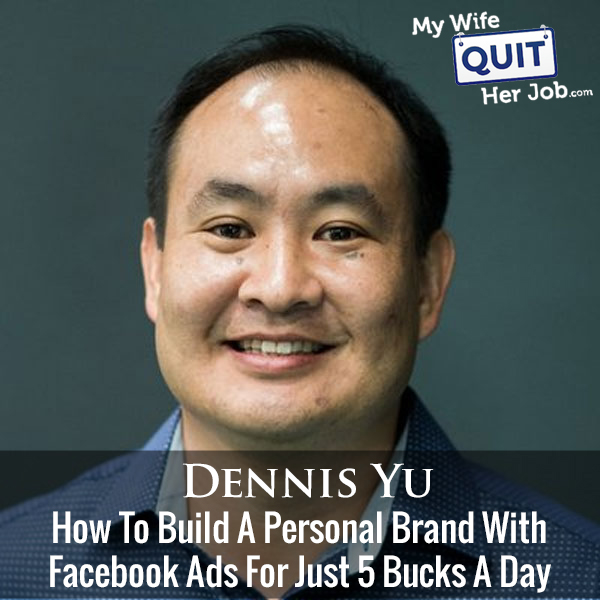
Dennis is the CTO of BlitzMetrics, which partners with schools to train young adults to run social campaigns for enterprise clients. He built American Airlines’ website roughly 20 years ago, started analytics at Yahoo, and has been featured in the Wall Street Journal and the New York Times.
Below is his method for going from nothing to recognized in a niche, how the $1 a day campaign works, and the metrics that tell you whether a post deserves more money.
Get My Free Mini Course On How To Start A Successful Ecommerce Store
If you are interested in starting an ecommerce business, I put together a comprehensive package of resources that will help you launch your own online store from complete scratch. Be sure to grab it before you leave!
Table of Contents
Key takeaways
- Perceived authority always precedes actual authority, and you can build it by association before you have proof.
- Interview people on video for one minute each, then run those clips as $1 a day engagement ads targeted at that person’s audience.
- Target the specific audience who cares about the person in your video, not a broad demographic.
- Run each post at $1 a day for seven days, expect 5% to 10% to become winners, then run winners for a year.
- Average Facebook video watch time is six seconds. Aim for 15 or more on a one-minute video.
- Relationships are built through frequent lightweight touches that act as deposits before any withdrawal.
- Dennis does not do outbound sales at all, relying entirely on inbound built from those touches.
- Most of BlitzMetrics’ large consulting clients bought a small course first.
Why relationships work like a bank account
Dennis’s framing is that everything you do creates a deposit or a withdrawal in every relationship. Your personal brand is the running balance of all of them.
Ask for a favor or for money without a positive balance and the check bounces.
The insight comes from his time at Yahoo, where he had visibility almost nobody gets into how relationships form at scale. Analyzing Yahoo Personals, they found the distinguishing feature of solid long-term relationships was frequency: many frequent lightweight touches over time.
Examining messages between people in established relationships, the content was often trivial. Yes, no, a laugh, small acknowledgments.
His business relationships work identically. A textbook publisher first contacted him years ago asking for an expert session on Facebook ads, he said yes, and tens of thousands of students and professors have since seen it.
How to start building authority from zero
Dennis’s answer for someone with no audience and no reputation is to interview other people who have expertise, real or perceived, and capture one-minute videos.
At a conference with 6,000 people, you can find speakers at lunch tables or after sessions. Not immediately before they go on stage.
Ask one question rather than five. Collect a series of these.
You need no brand, no expertise, and no comfort on camera, because you are pulling out a phone and getting their perspective. Dennis describes this as what he did for the first 20 years of his career before spending the next 20 paying it forward.
His criticism is aimed at people who skip to the main stage without the experience or knowledge and believe they are fooling everyone. He posted about people fraudulently promoting a lifestyle they do not have, owing people money, posing in front of vehicles they do not own, and burning relationships to maintain the appearance.
His position is that people spend so much effort maintaining a facade that they never invest in actually knowing anything.
How to get on an influential person’s radar
Pick the area you want authority in, search for who already has it, and follow them. Dennis’s phrase is that you have to creep on people in a non-creepy way.
Retweeting their work is not intrusive, it is participating in the community. Comment on their blog posts, comment on their company page, write them a review, say thank you.
The distinction that matters is depth. “Great article” or “awesome job getting featured in Entrepreneur” is not engagement and does not demonstrate you have earned the right to a conversation.
Dennis says 99% of people who approach him are immediately disqualified because they lead with the ask: get me a blue checkmark, introduce me to Mark Zuckerberg, get me Warriors tickets. From strangers.
His analogy is walking up to someone you have never met and asking for their car keys.
His view on why people do it: they assume the internet is large enough that volume compensates. That is the same logic as blasting a dating profile or mass-mailing a resume, and it is what spammers do.
He prefers a Warren Buffett approach. Research a few carefully and concentrate there, rather than spreading across a thousand.
He is also emphatic that busy successful people are generally helpful, and the main thing they ask is that you not be one of those people. He describes a lunch with Robert Scoble that they had to abandon because strangers kept interrupting to pitch and take photos.
Turning contact into content
Once you have a relationship, interview them. A one-minute video, or five minutes on a video call, or a single question.
The listicle version works well: reach out to ten people, ask each for one tip, and assemble an article. That is how “what 150 experts say about X” pieces get made.
The condition is doing the research first. Ask a question demonstrating you have done homework, and most people reply.
His warning is about mass-blasting the same request to everyone, and worse, using VAs or bots to do it. He received three automated LinkedIn lead-gen pitches the day of this interview and replied that he would pay for his competitors to use that service.
How the dollar a day Facebook strategy works
Take the video and boost it for $1 a day, targeting the people who care about that specific topic: attendees of that conference, readers of that book, followers of that person.
If Dennis has an interview with Robert Scoble, he targets Robert Scoble’s audience. If he has video from the Golden State Warriors’ headquarters talking about digital marketing, he targets people working with the Warriors, at ESPN, and in the NBA.
The aim is maximum relevance. Who would care about this specific piece of content.
The goal is engagement, not sales
The objective is an initial touch and nothing else. No selling, no withdrawal.
What it demonstrates is that you gather useful information and distribute it without an ulterior motive. And people judge you by who you are around.
Dennis’s example is his co-founder Logan Young appearing on CNN and testifying before Congress, never mentioning their packages, their consulting, or that the company has spent a billion dollars on Facebook ads.
His question: who would you assume is better at Facebook ads, the person seen with Mark Zuckerberg, or the person telling you directly that they are good and you should hire them.
That is perceived authority. Actual authority is having the proof, the process, and results a client can verify.
The $250 to $1,000 example
Three years before this interview, Logan Young was delivering pizza at $9 an hour. He learned to optimize Facebook ads following BlitzMetrics’ published systems, and they began charging $250 an hour for his time.
Then Zuckerberg approached him at a conference for a photo, and his rate became $1,000 an hour with better clients.
Dennis’s point is direct: hanging out with Zuckerberg for a few minutes did not make him four times better at Facebook ads. He already had the actual authority. The photograph supplied the perceived authority that let him charge four times as much.
How that meeting happened is itself the lesson. It came from years of lightweight touches: meetings at Facebook, participation in betas, helping build the initial Power Editor. At one conference Logan was the only person wearing a Facebook shirt, obtainable only at Facebook headquarters, and Zuckerberg asked where he got it.
Which metrics tell you a post is working
| Metric | Target |
|---|---|
| Average video watch time | 15+ seconds on a one-minute video, against a six-second platform average |
| Cost per 3-second view | 2 cents or less |
| Cost per 10-second view | Under 5 cents |
Watch time is the first diagnostic. People bailing after three seconds means they are scrolling past, which usually traces to missing captions, an uninteresting opening, a blank conference-room wall behind you, or a logo and name card nobody cares about.
At five cents per 10-second view, a single dollar buys 20 people watching for at least 10 seconds. Ten dollars buys 200 of the right people hearing you or seeing you alongside someone authoritative.
Facebook’s relevance score, which Dennis discusses as a check-engine light, has since been retired and replaced with a set of ad relevance diagnostics. The underlying principle holds: a metric telling you something is wrong without telling you what.
How to find your winners
Boost each post at $1 a day for seven days, so each post costs $7. Expect to publish 15, 20, or 100 of them.
Roughly 5% to 10% become winners. Those get $1 or $2 a day for 365 days.
Dennis’s caution is against continuously posting new content without extending the boosts on what already works. Some of their posts are three years old and still running.
He calls it the greatest hits model. Guns N’ Roses plays Paradise City every night because people want to hear it.
His other observation: the posts you think are excellent usually underperform, and the ones you are indifferent about often win. Let the numbers decide.
Public figure page vs personal profile
Run this from a public figure page rather than your personal profile. A profile has friends and no analytics, and cannot boost posts.
A public figure page is a category of business page carrying your name and photo, looking much like a profile, with fans instead of friends plus ads and analytics.
For most of this, boosting directly from the page works fine and is equivalent to running an engagement campaign in Ads Manager. Ads Manager matters when you need conversions, leads, or more complex objectives.
Why Dennis never reaches out to sell
Dennis expects disagreement on this: he does not do outbound selling at all and relies entirely on inbound.
His example from that day was someone buying a $1,500 annual private membership having never met him, saying he had followed the work for years and had now reached the point where he was ready.
His honest admission as an analytics person is that this is not fully trackable. No analytics tool would have surfaced that person’s readiness.
His metaphor: personal branding is gardening rather than a vending machine. You plant seeds and they grow on their own schedule.
What is partially visible is who engages. When someone comments or asks a question and you answer helpfully rather than selling, their name tends to reappear a couple of weeks later buying a $97 course.
The ascension path
Engagement audiences do get remarketed, which is different from calling people who filled in a form.
Someone who watched video one for more than 10 seconds in the last 30 days sees video two, or a landing page offering a lead magnet in exchange for an email address.
The email sequence delivers substantial free value, which makes a $7 offer feel obvious given what they received for nothing. That leads to a $189 course with video lessons, quizzes, and a certificate.
Dennis’s observation is that most people spending $10,000 a month on consulting bought something small first, usually a $97 course.
On tripwire pricing, his answer is that it depends entirely on the audience. Selling high-end B2B software makes $1,000 a tripwire on a million-dollar package. Teaching a beginner guitar chords makes the tripwire $1 or $2 against a $17 course.
Email versus Messenger subscribers
Dennis’s advice is both. Messenger subscribers cost roughly a third of an email subscriber, and he still values an email address more because you own the information and Messenger limits what you can send.
His method for getting both is a comment-triggered lead magnet in Messenger, then asking for an email address inside the conversation, framed as a backup in case you get disconnected. He reports opt-in rates in the 80% to 90% range.
His caution about chatbots is that most people build them as auto-responders, jamming email copy through a channel that cannot carry it. Chat has to be genuinely lightweight and conversational, closer to yes, no, or A, B, C.
Facebook has since substantially restricted promotional messaging in Messenger, so the specific tactics here no longer work as described. The email capture principle stands.
Getting consent to use someone’s video
Asking “I’d like to interview you for a one minute video” and receiving a yes is lightweight verbal consent, which Dennis treats as sufficient.
Prepare your topics before you need them
Dennis’s practical warning: the worst outcome is meeting someone notable and having nothing to say.
Map out the handful of topics you care about in advance, what BlitzMetrics calls a topic wheel, so you are ready when the opportunity arrives. Improvising on the spot does not produce what you wanted.
You can find Dennis on LinkedIn, where he has more room than on Facebook, and at BlitzMetrics.
Frequently asked questions
What is the dollar a day Facebook strategy?
Boosting individual posts at $1 a day for seven days each, targeting the specific audience who cares about that content, then identifying the 5% to 10% that perform and running those for a full year. The objective is engagement rather than sales.
What is perceived authority?
Credibility people assign you based on association and visibility before they can evaluate your actual competence. Dennis Yu’s position is that perceived authority must precede actual authority, since nobody can assess your skill until they have first decided you are worth listening to.
What Facebook video metrics should you aim for?
Average watch time above 15 seconds on a one-minute video, against a platform average of about six seconds. Cost per three-second view of two cents or less, and cost per ten-second view under five cents.
How do you build authority with no audience?
Interview people who already have expertise, capture one-minute videos, and distribute them to that person’s audience. You need no brand or on-camera skill because you are asking questions rather than presenting.
How do you get an influential person to notice you?
Engage substantively over time rather than leading with a request. Retweet, comment thoughtfully on their posts, and write reviews that demonstrate you actually consumed the work, since generic praise does not distinguish you.
Should you boost posts or use Ads Manager?
Boosting from your page is equivalent to running an engagement campaign and is simpler for this strategy. Ads Manager becomes necessary when you need conversions, leads, or more complex campaign objectives.
Should you use a personal profile or a public figure page?
A public figure page, which is a business page carrying your name and photo. Personal profiles have friends rather than fans and cannot boost posts or access analytics.
Do most big clients start with a small purchase?
At BlitzMetrics, yes. Dennis reports that the majority of clients spending around $10,000 a month first bought something small, typically a course under $100.

