
Podcast: Download (Duration: 48:10 — 55.4MB)
Most people start a business strong and fizzle out when the immediate gains do not arrive. James Clear’s answer is that habits are the compound interest of self-improvement, and the entire game early on is showing up consistently rather than showing up harder.
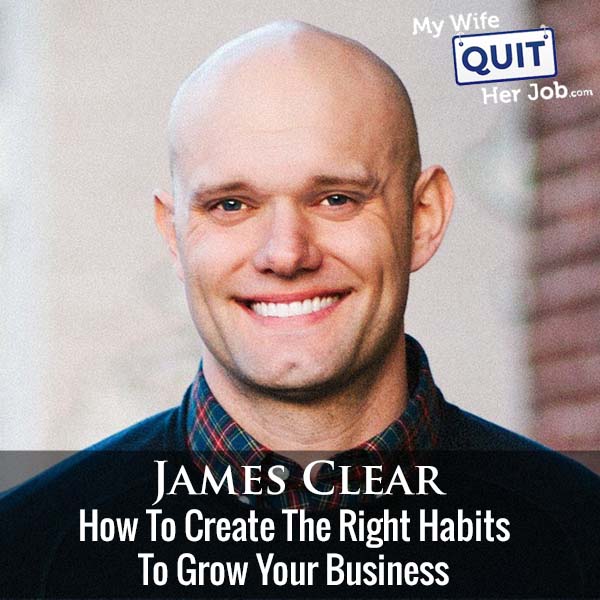
James is a New York Times bestselling author and the writer behind Atomic Habits, which hit number three in business on the Times list and at one point was the number eight bestselling book on all of Amazon. He was last on the show in episode 202 discussing how he built a blog to millions of visits a month.
Below are his Four Laws of Behavior Change applied to business, the two-minute rule, why willpower is really environment design, and what it actually took to hit the bestseller list.
Get My Free Mini Course On How To Start A Successful Ecommerce Store
If you are interested in starting an ecommerce business, I put together a comprehensive package of resources that will help you launch your own online store from complete scratch. Be sure to grab it before you leave!
Table of Contents
Key takeaways
- The Four Laws of Behavior Change: make it obvious, make it attractive, make it easy, make it satisfying. Invert all four to break a bad habit.
- The two-minute rule scales any habit down to its first two minutes, because a habit must be established before it can be improved.
- People with high self-control are not tougher. They live in environments with fewer temptations.
- Temptation bundling pairs something you want to do with something you need to do.
- Habits that match the norms of your tribe become attractive, which is why joining the right group changes your behavior.
- The goal is to become an entrepreneur rather than to build a business. Every small action is a vote for that identity.
- Your outcomes are a lagging measure of your habits: subscribers lag writing, weight lags eating, bank balance lags financial habits.
- James wrote two articles a week for three years before any of it compounded into a book deal.
Why habits are the compound interest of self-improvement
Habits multiply the same way money does through compound interest. You save a little, it feels like nothing, the curve stays almost flat for a long stretch, and the hockey stick arrives years or decades later.
The difference between a burger and a salad on any given day is nothing. The scale does not move, the mirror looks the same that night.
Look back five or ten years and that lunch choice turns out to have mattered enormously. That is the core idea behind Atomic Habits: find ways to get 1% better each day and let the small advantages accumulate.
The same applies to a business. A 1% margin of improvement daily in what you do, or monthly in your financials, adds up substantially over a long span.
What a 1% gain looks like in practice
You do not need to do more than you are already doing. You need to show up more consistently than you have before.
James is explicit that this is not about intensity. You do not need to write a radically better blog post or become massively better at sales calls. You need to make it easy to show up and do those things more often.
The gym version: do the same workout, just miss fewer of them.
In his own business, that meant a new article every Monday and Thursday for three years. That consistency is what built the audience, which produced the book deal.
The two-minute rule for starting any habit
Scale the habit down to its first two minutes. Read 40 books a year becomes read one page.
Call 20 clients a month becomes make one sales call. Do yoga four days a week becomes take out my yoga mat.
It sounds absurd until you see what it accomplishes. One of James’s readers lost over 100 pounds partly by going to the gym and not allowing himself to stay longer than five minutes.
Five minutes at the gym does not get you in shape. What it does is master the art of showing up.
The principle underneath is that a habit must be established before it can be improved. If you never become the person who goes to the gym for five minutes, you never get the chance to become the person who trains 45 minutes four days a week.
Decisive moments
James calls these gateway habits, and the moments around them decisive moments: the two minutes that determine the next chunk of time.
His own example is sitting down at the computer each morning and either opening Evernote to work on the next article or opening ESPN to check scores. The next hour of his day is determined by roughly 45 seconds.
Master that one moment and you have a productive hour ahead. Whatever your business looks like, there are probably four to ten of those decisive moments in a day, and putting your energy into those specific junctures is what produces a productive day.
Why willpower is really environment design
People who appear to have enormous self-control are mostly people who are tempted less. The research James covers in chapter seven of Atomic Habits finds that high self-control individuals live and work in environments with fewer temptations.
The common narrative is that you need to want it more, try harder, show grit. Working hard is genuinely valuable and it is the wrong lever to pull first.
The best lever is redesigning your environment. Put the objects that prompt good behavior in obvious locations and reduce the friction of good tasks. Put the things that derail you in less obvious locations and increase the friction of unproductive behavior.
The Four Laws of Behavior Change
Every habit runs through four stages: cue, craving, response, reward. A cue captures your attention, you form a prediction about what it means, you take an action, and that action delivers a result.
James’s bread example makes it concrete. You walk into the kitchen in the morning, see a loaf of bread, predict that toast would be good, make it, and eat it. Ten minutes after breakfast you walk in, see the same loaf, and nothing happens, because your state changed and the cue now means something different.
Each stage produces a corresponding law.
| Stage | To build a good habit | To break a bad one |
|---|---|---|
| Cue | Make it obvious | Make it invisible |
| Craving | Make it attractive | Make it unattractive |
| Response | Make it easy | Make it difficult |
| Reward | Make it satisfying | Make it unsatisfying |
James frames these as a toolbox rather than a checklist. All four will not always work in your favor, so when one is not available you pull the other three.
How to make boring business work attractive
A lot of building a business is genuinely tedious, which makes “make it attractive” the hardest law to apply. The tactic for this is temptation bundling: stack something you enjoy with something you know you need to do.
James’s example is an engineering student who wired his computer to a stationary bike so Netflix would pause whenever he stopped pedaling. Watching a 30-minute show meant cycling for 30 minutes.
Another is a woman who only gets a pedicure while working through overdue emails. Katie Milkman, the Wharton researcher who named temptation bundling, allowed herself to read The Hunger Games only while on the treadmill.
Someone James worked with hated taking calls and hated being hunched at a desk all day, so he changed his rule: meetings only happen while walking through the park near his office. Taking a meeting became going outside.
Turning habits of avoidance into something positive
Habits of avoidance are inherently miserable because you are only ever not doing something. No alcohol for 30 days, no spending on Amazon, no eating out.
One of James’s readers and his wife wanted to eat out less. Rather than white-knuckling the temptation, they opened a savings account labeled “trip to Europe” and transferred $50 into it every time they cooked at home instead.
They still did the work of cooking, and they got the immediate satisfaction of watching the account grow. That is the general principle: find a way to attach immediate enjoyment to the difficult thing.
My own version came from my mother, who took me for ice cream after every piano lesson I hated. Eventually I looked forward to the lessons, because the cue had been reframed.
Why your tribe determines which habits feel attractive
The social environment changes which habits are attractive to you. No child grows up wanting to think about email funnels, and it is genuinely interesting to James now, partly because his skills improved and substantially because he gets rewarded for it.
Not just financially. People congratulate him, ask how he grew the list, treat it as impressive. Those social signals make conversion rates and form design more attractive to work on.
Put him with college friends who neither know nor care about email lists and the same number means nothing. Working on it becomes less attractive in that room.
We all belong to multiple tribes, large ones like a nationality and small ones like a local gym or a street. Each carries shared expectations for how members behave.
You face the front of an elevator. You wear something formal to a job interview. Nothing forces you to, and violating the shared expectation feels wrong.
Habits that go with the grain of your tribe are attractive. Habits that go against it are not.
How to change your tribe deliberately
Join a group where the behavior you want is the normal behavior. If it is normal there, doing it helps you fit in, which makes it attractive.
This mattered enormously for James, who had no entrepreneurs in his family and no close friends running businesses. In his first three to six months he emailed well over 100 people already doing full time what he wanted to do, asking to chat on Skype.
Most said no. Roughly 30 said yes.
Six months in he had a few dozen people to bring problems and ideas to, and more importantly he could observe what they did daily. You absorb that without consciously asking, the same way people who join a CrossFit gym end up eating paleo and buying particular shoes.
He attended his first conference six months in already knowing about 10 people from those Skype calls, so he did not arrive cold. He did conferences for two or three years and now hosts his own small events, usually around eight people, as a high-touch way to absorb what everyone else knows implicitly.
This matches my own experience exactly. My business started taking off when I started going to events.
Choosing your children’s environment
Children are master imitators, which any parent of a two-year-old can confirm. As they age they imitate their parents less and their peers more.
James points to The Nurture Assumption by Judith Rich Harris on peer group influence. Parents have significant influence and much of it is genetic, passed through the genes.
The lever parents actually control is environment: which city you live in, which school they attend, which activities they join. In other words, which other children they are exposed to.
That is more effective than trying to force a behavior directly.
How to persist through the plateau before results arrive
James’s metaphor is an ice cube in a 25-degree room. The temperature rises to 26, 27, 28, 29, 30, 31 and nothing visible happens. At 32 the cube begins to melt.
That final one-degree shift is no different from the ones before it, and suddenly something new happens.
Building a business works the same way. You are stuck on a plateau of latent potential, banking reps and effort and time with nothing to show for it, and the ice cube has not melted yet.
Simply knowing this happens helps, because it resets the expectation. We assume progress is linear, that a little work yields a little result and a lot of work yields a lot. It is closer to that compound curve, where the greatest gains are delayed.
Why identity beats goals
The deeper reason small habits matter is that they reinforce an identity. James reframes every goal one level up: the real goal is becoming a runner, and becoming a writer.
For business, the real goal is becoming an entrepreneur, a creator, someone financially independent.
Every action is a vote for the type of person you want to become. Making your bed embodies being organized.
Writing one sentence embodies being a writer. Making one sales call embodies being good at selling.
No single vote counts for much. Each one adds to a mound of evidence about who you are.
James’s framing is that true behavior change is identity change. Saying “I want a million dollar business” is very different from saying “I am an entrepreneur,” because once you believe the second one you are no longer pursuing behavior change at all. You are acting in alignment with who you already believe you are.
On a hard day in business, the question is how to cast a vote for the desired identity even when results are far off. After a long travel day, five pushups before collapsing is not the result you want, and you are still the kind of person who does not miss workouts.
This is distinct from puttering. Doing a pile of frivolous small tasks feels like wasted time. The point is taking a small action that reinforces the identity you are building.
How to work out which identity you need
Most people struggle with questions like “what are your values,” and most people do know what results they want. So start there and reverse engineer.
You want to lose 40 pounds in six months. Who is the type of person who could do that? Probably someone who does not miss workouts.
You want to double your income. Who could do that? Maybe someone who creates one new product a month.
Applied to writing a book: who could write a New York Times bestseller? Possibly someone with an email list of hundreds of thousands to tell about it.
Who has a list of 500,000? Someone who writes every week.
That becomes the identity: I want to be the type of person who writes every week.
The line of questioning clarifies that your outcomes are a lagging measure of your habits. Subscriber count lags your writing habit, weight lags your eating habits, your bank account lags your financial habits.
What it actually took to hit the New York Times bestseller list
James’s honest accounting runs to roughly six years. Two articles a week on JamesClear.com starting in 2012, sustained for three years, building to around 200,000 to 250,000 email subscribers.
He leveraged that platform for introductions to agents and publishers, spent three months on a book proposal, pitched 19 publishers, got meetings with seven, received bids from four, and picked one.
The contract called for a book in one year. It became apparent he needed more, so he asked for a second year and got it, then delivered three months past the extended deadline. Two years and three months of writing and research, which he describes as the hardest and most miserable part, because writing under contract carried real expectations.
Then nine months of launch planning and marketing. In the final 10 to 12 weeks he did 85 interviews, wrote a stack of blog posts, emailed his own audience, and called in every favor available, culminating in a CBS This Morning segment on launch day.
How the bestseller lists actually work
Roughly 10,000 copies in a week is the rule of thumb people cite for the New York Times list, and hitting it guarantees nothing. It depends on your category and on what every other book sold that week.
The Times list is a black box and makes editorial decisions. It may conclude a book is not the kind it wants to feature, or that the sales pattern looks suspicious.
James heard of an author who sold 4,000 individual copies plus a single 6,000-copy corporate purchase. The Times appears to weight that closer to 4,001, favoring the author with 10,000 individual readers.
Lists like Publishers Weekly and USA Today are more straightforwardly sales-driven.
Why James refused to game it
Plenty of people do. Speakers buy 10,000 or 20,000 copies that sit in a garage, and others trade their speaking fee for a bulk book purchase during the launch window.
Services once existed that would take tens of thousands of dollars and have employees place thousands of individual orders across the country to disguise a bulk buy.
James was adamant that every copy sold go to an actual person.
Beyond the ethics, which he considers questionable on their own, his reasoning is about what the achievement would mean. He spent six years building an audience and three years writing and planning the launch, and hitting the list felt good precisely because of that sacrifice.
Getting there by writing a check would have been a completely different experience.
You can find the book at atomichabits.com, which also hosts bonus material including guides on applying the ideas to parenting and to business, a cheat sheet of the core concepts, and a habit tracking template.
Frequently asked questions
What are the Four Laws of Behavior Change?
Make it obvious, make it attractive, make it easy, and make it satisfying. Each corresponds to one stage of the habit loop, and inverting all four breaks a bad habit instead of building a good one.
What is the two-minute rule?
Scale any habit down to its first two minutes, so reading 40 books a year becomes reading one page. The point is that a habit must be established before it can be improved, so mastering the act of showing up comes first.
Do people with high self-control just have more willpower?
No. Research James Clear covers in Atomic Habits finds they generally live and work in environments containing fewer temptations, so they exercise willpower less often rather than more successfully.
What is temptation bundling?
Pairing something you enjoy with something you need to do, like only watching Netflix while on a stationary bike or only reading a favorite book at the gym. It attaches immediate enjoyment to an otherwise unattractive task.
How does your social group affect your habits?
Habits that match the shared expectations of your tribe feel attractive because performing them helps you belong, and habits that go against those expectations feel unattractive. Joining a group where your desired behavior is normal is one of the most effective ways to change what you do.
Why should you focus on identity instead of goals?
Because every small action is a vote for the person you are becoming, and once you genuinely believe an identity you are no longer forcing behavior change. James’s framing is that the real goal is becoming an entrepreneur.
How do you stay motivated before you see results?
Expect a plateau, since progress compounds rather than moving linearly, and focus on casting votes for your desired identity rather than on outcomes. James compares it to an ice cube warming from 25 to 32 degrees, where nothing appears to happen until it suddenly does.
How many copies do you need to sell to hit the New York Times list?
Roughly 10,000 in a week is the commonly cited rule of thumb, and it guarantees nothing. The list depends on your category, what other books sold that week, and editorial judgment about whether the sales look legitimate.