

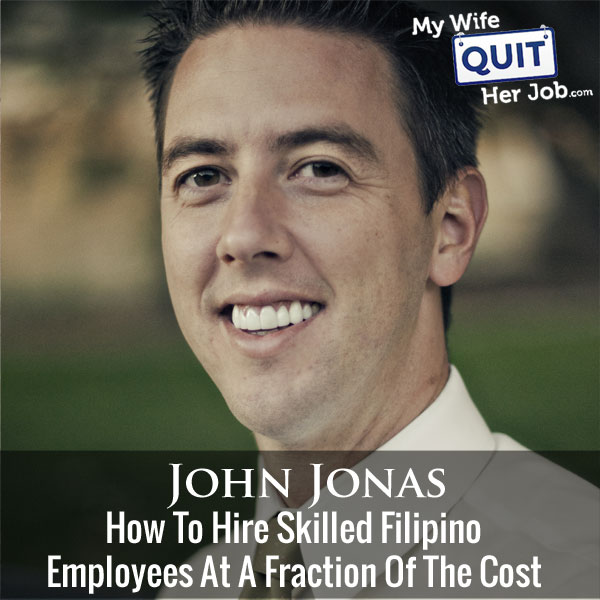
Podcast: Download (Duration: 49:39 — 68.5MB)
You hire Filipino virtual assistants for retention rather than for cheap labor, and the cost savings are the side effect. John Jonas has had the same programmer working for him for twelve years, and that continuity is what lets him hand over work he would never trust to a rotating contractor.
John is the founder of OnlineJobs.ph, the job board built specifically for Filipino workers. He quit his job in 2004, hired his first Filipino worker within two years, and now works about twelve hours a week because he has given away almost everything else.
This episode covers what full time Filipino workers actually cost, why John refuses to run Skype interviews, the email-based interview process he uses instead, and how to stop a worker from disappearing on you.
A note on timing: this is a 2017 conversation. Salary figures have risen since, and platform features have changed. The cultural and management guidance holds.
Get My Free Mini Course On How To Start A Successful Ecommerce Store
If you are interested in starting an ecommerce business, I put together a comprehensive package of resources that will help you launch your own online store from complete scratch. Be sure to grab it before you leave!
Table of Contents
Key takeaways
- A full time PHP developer in the Philippines ran $800 to $1,200 a month at the time, roughly a tenth of a comparable US salary.
- Filipino workers are hired as permanent full time employees rather than per-project contractors, so turnover is far lower than on hourly marketplaces.
- Skip Skype interviews. Roughly three of five scheduled candidates will not show, and you lose strong candidates who fear being judged on spoken English.
- Interview by email over one to two weeks, asking several questions per message, which reveals responsiveness and attention to detail that a profile cannot fake.
- Trust runs both directions. A worker who is unsure whether you approve of their work will hold back rather than take initiative.
- The “disappearing Filipino” problem is an employer problem about 97% of the time, and it usually means the worker got stuck and was too embarrassed to say so.
- Tell new hires explicitly that disappearing is the worst thing they can do, and go find them when they go quiet.
- Screen-capture video beats written specs. Hearing your voice builds the trust that makes the rest work.
Why hire virtual assistants from the Philippines instead of other countries?
Because the combination of English fluency, low turnover, and cultural fit is hard to find elsewhere. John was pointed toward the Philippines twelve years ago after painful outsourcing experiences in other markets, and the first hire changed his business.
The communication difference was immediate. He describes never having had a language misunderstanding, in contrast to prior experience where a “yes” meant “I heard you” rather than “I understood you.”
The retention is the part that compounds. His first hire still works for him today and now runs businesses that have generated hundreds of thousands of dollars.
There is also a structural reason turnover is low. Filipino workers in John’s experience are not especially entrepreneurial, so they are unlikely to learn your business and leave to compete with you.
He tried hiring locally first. He taught four different US contractors what he was doing, and the first thing each of them did was quit to do it themselves.
What does a full time Filipino developer cost?
Between $800 and $1,200 a month for a full time PHP programmer, against roughly $70,000 a year for a comparable US developer. That is a factor of ten rather than a factor of two.
John employs four full time PHP programmers at that rate and says he would put them up against nearly anyone. His iOS developer costs $1,200 a month.
The output math does not close the gap. You might get more from a US hire, possibly twice as much on a good day, and never ten times as much.
The same ratio holds outside development. His highest paid person in the Philippines runs ads at $8 to $12 an hour, where the equivalent US hire costs $50 an hour.
What jobs should you outsource to the Philippines?
Programming, graphic design, admin work, customer service, and social media all work well. John runs all of those functions out of the Philippines.
Customer support runs across time zones by staffing shifts. He hired three people to cover three eight-hour shifts, plus a fourth to fill gaps.
Phone support is possible even though he does not do it. Internet voice systems make it straightforward if you want it.
Writing and creative direction are where he keeps US talent. He employs US writers and an advertising lead because their style and creative judgment fit what he wants.
Even that split is not absolute. He notes that readers of his blog cannot reliably tell which posts were written in the US and which in the Philippines without checking the byline.
Should you worry about code quality when outsourcing development?
Less than you think, because John sees the opposite failure far more often. Entrepreneurs polish code and features to perfection and never get around to making sales.
He would outsource complex applications without hesitation. His Windows application and his iOS app were both built by full time Philippines-based developers who handled unusual requirements and still maintain the code.
Full time employment is what protects you from technical debt. When the person who wrote the code stays for years, problems get fixed by the person who understands them.
How is OnlineJobs.ph different from Upwork?
Turnover is the core difference. Upwork is built around completing a job, getting paid, collecting feedback, and moving to the next client, which guarantees you a stream of new workers.
The pricing model reflects that. On Upwork people quote an hourly rate for a defined task, while on OnlineJobs.ph they quote a monthly salary for ongoing employment.
Ratings are sparse there for a revealing reason. When employers find someone good, they hire them permanently and have no incentive to advertise that person to everyone else.
The fee structure is a flat recruiting cost. You pay $50 a month to recruit, hire as many people as you want during that month, then cancel, and the platform takes no cut of anyone’s salary afterward.
Why you should not do Skype interviews with Filipino candidates
Because you will lose your best candidates before you ever speak to them. John schedules five interviews and roughly three and a half people do not show up.
The reason is fear of being judged on spoken English. Candidates understand American speech from television and movies, and they worry you will not understand them and will be disappointed.
Equipment is the other filter you do not want. A candidate without a microphone learns that a Skype interview is required and simply stops applying, and that can be an excellent programmer who never needed to be on a call.
How do you interview a Filipino virtual assistant by email?
Send one or two emails a day for one to two weeks, asking several specific questions in each. The length of the process is the point, since it surfaces traits a polished profile hides.
Attention to detail shows up immediately. Ask four questions, see how many get answered, and you learn something no resume tells you.
Responsiveness is the other signal. A candidate taking two days to reply during an interview will take two days to reply after you hire them.
Sustained written English is hard to fake. A friend may have helped polish a profile, and nobody ghost-writes a dozen email exchanges over two weeks.
Live chat is a reasonable supplement with one caveat. It shows typing speed and connection quality, and a candidate can neutralize both by going to an internet cafe.
The process moves faster than it sounds. Responsive candidates get a reply every time they answer, and overlapping working hours mean you can run a full set of questions in about three days.
Should you give candidates a paid test task?
Yes, and you must say up front that you will pay for it regardless of the hiring outcome. Filipino candidates are wary of doing work and not getting paid.
John uses test tasks occasionally rather than routinely, sometimes running the same task past several candidates. The paid framing is what makes people willing to participate.
How do you build trust with a Filipino employee?
Extend trust first, because a worker who is unsure of you will hold back. John’s framing is to treat the person as though they are sitting next to you.
The cultural mechanism is face. Filipino workers strongly want to please, and someone who doubts they can satisfy you plays it safe rather than doing their best work.
Withheld trust compounds in the wrong direction. Instead of getting bolder and trying to impress you, an uncertain worker gets more hesitant, and eventually goes quiet.
Patience is the trait that predicts success. John describes an employer who rejected a proven four-year employee after a single day over one late start and one misread instruction, and he told that employer not to hire in the Philippines at all.
Employers who succeed treat mistakes as maintenance. They point out the error, fix it, thank the person for the effort, and move on.
Why do Filipino workers stay when they get better offers?
Because loyalty in that culture is not purely transactional. One of John’s employees, placed in a client-facing role, told him she receives job offers daily and has no intention of leaving.
Even departures come with loyalty attached. His first programmer left after a Singapore offer at five times his salary, and volunteered to keep working part time at his old rate.
Retention is what unlocks real delegation. A worker of twelve years logs into John’s email each morning and archives everything he does not need to see, which is not something you would ever teach a contractor.
That delegation is why he works about twelve hours a week. Everything else has been handed to someone who is going to still be there next year.
How do you avoid hiring a fake or fraudulent profile?
Check the ID Proof score, a zero to 100 rating of whether a person is who they claim to be. It exists because fake profiles are easy to create at scale, and some people collect many jobs while doing very little on each.
The algorithm came from pattern recognition. John reviewed thousands of profiles, catalogued the behaviors cheaters share, and encoded them.
A low score is a caution flag rather than an automatic rejection. Some genuine candidates skip the verification work because they doubt online jobs are real, which is a common attitude locally.
What is the “disappearing Filipino” problem and how do you fix it?
A worker doing good work suddenly goes silent, and about 97% of the time the cause sits with the employer. The worker got stuck, did not understand an instruction, or felt uncomfortable with a task, and could not bring themselves to say so.
Your instructions being clear is beside the point. If someone has gone quiet, you need a different way to explain the same thing.
The prevention is a conversation at hire time. John tells every new hire that they will get stuck eventually and will want to disappear, and that disappearing is the worst thing they can do.
It works often enough to be worth the two minutes. One employee opened an email with a line about not wanting to send it, sending it only because she had been told she could not disappear.
The recovery is to go find them. Reach out, say you know they are stuck, and ask what you can help with, and that resolves about 90% of these situations.
How should you communicate specs to a remote developer?
Record screen-capture video rather than writing everything out. John writes the specifications himself, stays closely involved with developers, and delivers instruction as video.
The videos run from a couple of minutes up to fifteen. He shows his screen and walks through exactly what he wants.
The trust effect is the underrated benefit. Hearing your voice regularly is how a remote worker comes to know you, which feeds directly back into how boldly they work.
It goes both directions in practice. Workers send screenshots and video of what they are seeing when they need a bug reproduced.
What should you expect from internet and power outages?
Scheduled outages of four to six hours a day happen in parts of the country during certain seasons, and you should plan for them rather than react to them. Workers typically message to explain and offer to make up the hours that evening or on Saturday.
Your reaction matters more than the lost hours. Yelling at someone in the Philippines costs you their trust in a way it would not in a US office.
Negative feedback needs a specific shape. Lead with something positive before delivering the criticism, and the difference in how it lands is substantial.
Frequently asked questions
How much does a Filipino virtual assistant cost per month?
At the time of this 2017 conversation, full time PHP developers ran $800 to $1,200 a month and an iOS developer $1,200. Advertising specialists were the most expensive at $8 to $12 an hour.
Is OnlineJobs.ph better than Upwork?
They serve different needs. Upwork suits one-off projects with hourly pricing and near-total turnover, while OnlineJobs.ph is built for hiring permanent full time employees at a monthly salary.
How much does OnlineJobs.ph charge?
$50 a month to recruit, with unlimited hires during that month. You cancel when you finish recruiting, and the platform takes no percentage of any worker’s salary.
Should you interview Filipino candidates over Skype?
No. Roughly three of every five scheduled candidates do not show up, largely from anxiety about being judged on spoken English, so you lose strong candidates before evaluating their actual skills.
How do you interview a Filipino worker without a video call?
Send one or two emails a day over one to two weeks with several questions each. You will see their written English, response speed, and whether they answer every question asked.
Why do Filipino workers stop responding?
They usually got stuck or did not understand an instruction and felt too embarrassed to admit it. Reach out directly, say you know they are stuck, and ask what they need.
What is ID Proof on OnlineJobs.ph?
A zero to 100 score estimating whether an applicant is genuinely who they claim to be, built from patterns observed across thousands of fraudulent profiles. Treat a low score as a reason for extra caution.
What jobs can you outsource to the Philippines?
Programming, graphic design, administrative work, customer service, and social media all work well. Creative writing and advertising strategy are the functions most often kept in-house.