
Podcast: Download (Duration: 29:03 — 40.2MB)
Dropshipping is getting harder every year, and Andrew Youderian sold his dropshipping business for that exact reason. Reselling other people’s products keeps getting more difficult, and the model only holds up in narrow niches where you can add real value: confusing purchase decisions, heavy pre-sale education, or products that need significant customer support before someone buys.
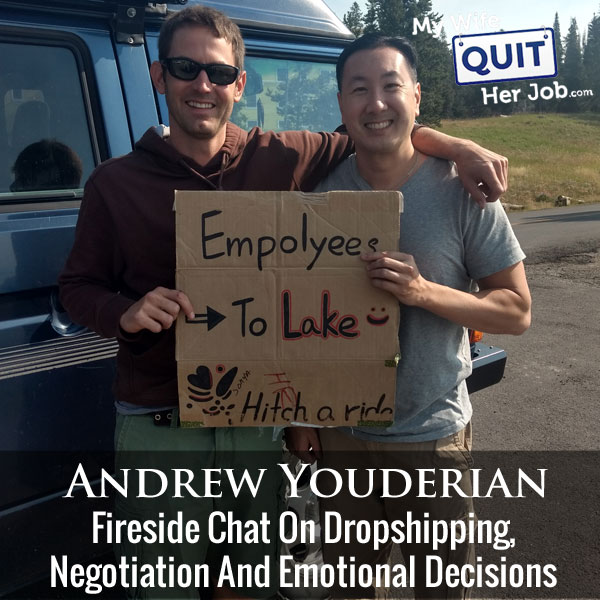
Andrew founded Ecommerce Fuel and has built and sold multiple stores, including Right Channel Radios (pure dropship) and Trolling Motors. I recorded this episode with him around a campfire on day three of a Montana and Yellowstone road trip, with no internet and nothing to do but talk shop.
This one covers where dropshipping still works and where it does not, how Andrew screened out fraudulent orders on $2,200 trolling motors, when to kill a product that is technically working, and how negotiating odds on a stupid campfire bet maps onto real financial decisions.
Get My Free Mini Course On How To Start A Successful Ecommerce Store
If you are interested in starting an ecommerce business, I put together a comprehensive package of resources that will help you launch your own online store from complete scratch. Be sure to grab it before you leave!
Table of Contents
Key takeaways
- Dropshipping keeps getting harder because reselling other people’s products offers buyers no reason to choose you over Amazon.
- Big ticket dropshipping attracts more competition, since zero inventory cost plus high profit per order draws in more sellers.
- Low-price dropshipping only works if you sell accessories alongside the main item, because that is where the margin lives.
- Fraudulent orders usually share four tells: mismatched bill-to and ship-to addresses, obviously fake email addresses, odd names, and an unreachable phone number.
- Andrew shipped $3,000 to $4,000 of trolling motors to scammers before tightening his order screening.
- Kill a product when growing it would still leave you with a small business that does not fit your strengths.
- When you are confident you are right, reduce the odds you offer rather than chasing a bigger payout. The outcome is the same and the risk is lower.
- Buying property purely on appreciation instead of cash flow is a bet that the appreciation continues.
Is dropshipping still a viable business model?
Dropshipping remains viable only in specific niches, and it gets harder every year. Andrew’s blunt read is that reselling other people’s products is increasingly difficult and will only get more so.
The niches that still work share a common trait: you can add enough value that the customer wants to buy from you specifically. That means confusing purchase decisions, products requiring heavy education, or categories where buyers need real support before they commit.
Andrew sold Right Channel Radios, his CB radio business, precisely because it was an exclusive dropship operation. The Trolling Motors sale had a different reason: it was the least profitable of the three businesses he was running at the time and he wanted his effort elsewhere.
What is the friction barrier in dropshipping?
The friction barrier is the reason a customer buys from your site instead of Amazon once they already know what they want. Andrew’s framing is that you can build the web’s best educational site for big screen TVs, with better product knowledge than anyone, and still lose the sale at the moment of purchase.
Education gets the customer to a decision. It does not automatically get them to check out with you.
That gap is what makes dropshipping tricky regardless of price point. You are selling an identical product that anyone else can also list.
Does dropshipping work better for high ticket items?
High ticket dropshipping is more viable per order and more competitive as a result. On a $1,000 trolling motor at 10% margins, you make $100 a sale with no inventory cost and no capital requirement, which is exactly why more sellers pile into those categories.
Andrew’s average order value in the trolling motor business was around $120 per horn on the accessory side of the catalog. The larger motors ran up to $2,200.
Low price points are much harder standing alone, because the profit per order simply is not there. Selling cheap dropshipped items only works when you attach accessories to the main purchase.
Accessories carry higher margins than the core product, which is where dropshipping actually makes its money at lower price points.
How do you spot fraudulent orders in ecommerce?
Fraudulent orders cluster around four signals: a bill-to address that differs from the ship-to address, an obviously fake email address, a name that does not make sense, and a phone number nobody ever answers. Andrew developed that checklist after shipping $3,000 to $4,000 worth of trolling motors to scammers.
Mismatched billing and shipping was the single strongest indicator. Almost every fraudulent order he received had different bill-to and ship-to addresses.
Fake email addresses were often comically obvious. Andrew found fraudsters frequently used addresses along the lines of 12345@gmail.com rather than anything resembling a real person’s account.
The phone check is the most reliable confirmation. Legitimate customers eventually pick up or return a voicemail within a couple of days, and fraudulent orders usually go unanswered.
What is a practical fraud screening rule for big ticket orders?
Flag every order where the bill-to and ship-to addresses differ, and only escalate those to a manual review. Andrew ran this rule on top of Shopify’s built-in risk analysis rather than manually reviewing every order.
If a flagged order also looked suspicious on the email address, the name, or the phone number, his team called or emailed the customer directly. Orders they could not confirm by phone or email never shipped.
That threshold keeps the workload sane. Big ticket items are where fraud actually hurts, and lower-value products in categories nobody scams for rarely need the same scrutiny.
Chargeback exposure scales with your price point. A fraudulent $2,200 trolling motor order is a very different problem from a fraudulent handkerchief order.
When should you discontinue a product that is still selling?
Discontinue a product when tripling or even 10x-ing it would still leave you with a business too small to be worth your attention. Andrew designed Rough Routes, a seat back organizer built to hold full paper atlases, and it still sells occasionally on Amazon.
He could put more marketing and content behind it and grow it meaningfully. His conclusion was that it would remain a small business, and one that does not play to his strengths or interests compared to Ecommerce Fuel and its job board.
The market size mistake happened at the design stage. Andrew acknowledges he did not think hard enough about how large the market was before building the product.
He knew that going in. He built it anyway for the education, and he was fine with the likely outcome.
Why build a product you know will not be a big business?
Building a small product from scratch is worth it when the experience itself is the return. Andrew designed Rough Routes specifically to learn how product development, supplier relationships, and Amazon selling actually work from the inside.
His role had shifted from store owner to running a community of store owners. Understanding what his members deal with day to day required living through it himself rather than reading about it.
He designed the product from the ground up instead of putting his brand on an existing item. That distinction matters: he created something new, bought a barcode, and listed it under the Rough Routes brand.
How does adjusting the odds on a bet reduce your risk?
When you are highly confident you are right, offering shorter odds gives you the same win with far less downside exposure. Andrew and I bet on whether a distant white patch, visible from a fire tower we hiked, was sand or snow.
He opened at five to one in my favor, then reconsidered. Being 99% sure it was snow meant a five to one offer risked $100 to win $20, and that 1% outcome would have stung.
His move was to express a little doubt and propose one to one instead. Hearing hesitation in his voice was exactly what convinced me to take the bet, so the feigned uncertainty both improved his odds and closed the deal.
It was snow. I owed him $20, and the takeaway holds well beyond a campfire wager.
Why offering longer odds gets more people to bet
Generous odds are what get a reluctant counterparty to say yes. Andrew’s observation is that most people decline a straight-up even bet and accept readily at three to one, five to one, or ten to one.
The skill is calibrating the odds you offer to your actual confidence level. Give away just enough to get agreement and no more, because every extra point of odds is pure downside if the unlikely case lands.
The same math applies to any decision with an uncertain payoff. When you can reach the same expected outcome while carrying less risk, take the lower-risk path.
Should you buy real estate for appreciation or cash flow?
Buying purely for appreciation means betting that prices keep climbing, since the property does not pay for itself in the meantime. Andrew pressed me on this when I said I would keep my Bay Area house if we moved to Los Angeles.
His question was direct: with 20% down, would the rent cover the mortgage, insurance, and maintenance? My answer was probably not, which makes it entirely an appreciation play.
My counter is that the house has more than doubled in nine years, rose about 20% last year, and is up double digits again this year. Bay Area land is finite, tech jobs keep arriving, and there is nowhere left to build.
Downside protection is the other half of my reasoning. In the 2007 and 2008 downturn, property where I live stayed roughly flat and fell at most 10%, so even flat appreciation would not lose money.
How emotional reasoning affects business and investment decisions
Emotional attachment shapes financial decisions even for people who consider themselves rigorously analytical. Andrew called out that my reasoning for holding the house was partly emotional, and he was right.
My parents built most of their wealth in real estate, and that shapes how I read the asset class. Rental income from a paid-off house also feels rock solid in a way that the same dollars invested elsewhere do not.
Andrew’s own example is the 30-year-old vehicle we drove across Montana, which he calls the worst financial decision of his life and which cost more than my BMW. It also made the entire trip possible.
That is the honest resolution. Non-financial reasons for doing things are legitimate, and the useful discipline is recognizing when a decision is emotional rather than pretending it was purely analytical.
Frequently asked questions
Is dropshipping dead?
Dropshipping is not dead, though it keeps getting harder as reselling other people’s products becomes more competitive. It still works in niches where you add real value through education, product expertise, or heavy pre-sale support.
What is the best price point for dropshipping?
Higher price points produce more profit per order, which also draws more competition into those categories. Lower price points only work when you attach higher-margin accessories to the main product.
How do you prevent chargeback fraud on expensive orders?
Flag any order where the billing address differs from the shipping address, then verify it by phone or email before shipping. Orders you cannot confirm through direct contact should not ship.
What are the warning signs of a fraudulent ecommerce order?
The main tells are mismatched bill-to and ship-to addresses, an email address that looks machine-generated, a name that does not make sense, and a phone number that goes unanswered for days. Any two together warrant a manual review.
When should you shut down a product line?
Shut it down when the realistic upside still leaves you with a small business that does not match your strengths or where you want to spend your time. Growth potential alone is not a reason to keep something.
What is the difference between private label and white label?
White label means putting your brand on an existing off-the-shelf product that other sellers also brand. Private label in the sense Andrew used it means designing the product yourself so nobody else can sell that exact item under their own name.
Should you buy a rental property that does not cash flow?
A rental that does not cover its mortgage, insurance, and maintenance is an appreciation bet rather than an income investment. That can work in supply-constrained markets, and you should be honest that you are betting on continued price growth.
How do you make less emotional financial decisions?
Start by naming the emotional component out loud instead of dressing it up as analysis. Then ask whether there is a way to reach the same outcome while carrying less risk.